


Malawi’s natural resources include fertile land, forests, rivers, Lake Malawi and minerals such as coal, uranium from the Kayelekera deposit, phosphates and graphite. What natural wealth does Malawi have? The country has 16.8 km³ of renewable freshwater resources, forest cover on 22.4% of its land and 662 recorded bird species.
Malawi, a country in southern Africa, has a wide variety of natural resources that are essential to the sustainability of its economy and its people. Malawi’s natural resources include fertile land, forests, rivers, lakes and minerals.
Table de contenidos
These resources are used for agriculture, fishing, industry and mining. Using them sustainably is vital to the country’s sustainable development and to preserving its biodiversity.
What are Malawi’s most notable natural resources? What natural wealth does the country have? How many mineral resources does it have, and where does it rank globally? How much water does it have, and what resources does it use to produce energy?
Natural resources
Natural resources are materials or energy sources provided by or found on Earth that are useful to humans. Every product we manufacture is made up of natural resources.
- Renewable resources: these can be restored by natural processes faster than the rate at which they are consumed. Examples include solar radiation, wind, hydroelectric power, water when used properly, and plant and animal life.
- Non-renewable resources: once extracted, these are depleted and cannot regenerate. Examples include hydrocarbons, metals and minerals.
Examples of Malawi’s main natural resources
Environmental indicators of Malawi
Official data on forests, water, energy and threatened species.
| Forest cover | 22.4% of land area2023 |
|---|---|
| Renewable freshwater per capita | 785 m³ per year2022 |
| Renewable electricity | 80.1% of total generation2021 |
| Threatened species | 126 mammals, birds, fish and plants2022 |
| Protected land area | 23.1% of land area2025 |
| Arable land | 42.4% of land area2023 |
Examples of Malawi’s mineral resources
In Malawi, coal reserves stood at about 802 million tonnes in 2023, but production is small: about 32,500 tonnes in 2024 (Worldometers, with EIA data). Malawi’s main coal-producing area is the Northern Region, home to the country’s main coal mines.
Other notable minerals include uranium, with the Kayelekera deposit among the most prominent, and phosphates, particularly apatite. Malawi also has bauxite. Kyanite and limestone are also found in abundance. There are rare-earth minerals such as monazite, as well as strontianite, a strontium mineral. The country also has deposits of graphite, sulfides such as pyrite and pyrrhotite, titanium minerals and vermiculite.
Water resources of Malawi
Malawi has 16.8 km³ of renewable freshwater resources, which places it 113th in the world. This African country, in the southeast of the continent, has important water resources, the most important being the Shire and Ruo rivers and Lake Malawi, the country’s main lake and one of the largest in Africa.

Average rainfall and soils of Malawi
Malawi has an average annual rainfall of 1,181 mm, which places it 64th in the world. Because of this moisture, Malawi’s soils are mostly red clay soils with a high capacity to retain water.
This makes agriculture an important activity in the country, although the heavy rainfall also causes soil erosion and degradation.
Renewable electricity and hydropower production in Malawi
In 2024, renewable sources supplied 96% of Malawi’s electricity generation of 1.8 TWh, and hydropower alone supplied 1.7 TWh (Ember, 2024), making it the country’s main source of electricity.
Malawi’s largest hydroelectric plant is the Kapichira Hydroelectric Power Station, on the Shire River, with an installed capacity of 128 MW.

Forest resources of Malawi
Malawi has forest area covering 22.4% of its territory (2023 data, according to TheGlobalEconomy/World Bank). Globally, it ranks 96th for forest area.
This resource is vital to the economy and to people’s well-being, especially in the Viphya forest region, Malawi’s main forest area.
Environmental performance and protection of Malawi’s natural resources
Malawi has an Environmental Performance Index (2024) score of 35.1 and ranks 158th in the Environmental Performance Index. In addition, protected areas make up 23.1% of its land area (World Bank, 2025).
Natural parks of Malawi: the hidden wealth of natural resources
Biodiversity: animal and plant resources of Malawi
Birds of Malawi
Malawi has a great diversity of birds, with a total of 662 species (according to worldrainforests.com), which places it 48th in the world for number of bird species. However, 19 of its bird species were threatened in 2018.
Conserving these species is an invaluable resource for the country; a standout is the African fish eagle, Malawi’s national bird and a symbol of its biodiversity and natural beauty.

Fish and amphibians of Malawi
Malawi has 79 amphibian species and 490 fish species (according to worldrainforests.com), notably the Malawi tree frog and the Malawi cichlid. Despite its natural wealth, the country faces the threat of extinction for 37 fish species (World Bank, 2022).

Globally, Malawi ranks 43rd for number of amphibian species and 125th for number of fish species.
Mammals of Malawi
Malawi has rich biodiversity, with a total of 210 mammal species (according to worldrainforests.com), most notably the hippopotamus. However, 10 of these species are threatened.
Globally, Malawi ranks 42nd for number of mammal species, and it has 3 endemic species, placing it 50th in the world ranking of endemic mammals.
Reptiles of Malawi
Malawi has a rich diversity of reptiles, with a total of 127 recorded species (according to worldrainforests.com), which places it 62nd in the world for number of species. Among the most notable is the Mount Mulanje chameleon (Nadzikambia mlanjensis), an endangered species endemic to Malawi’s Mount Mulanje.

Plants of Malawi
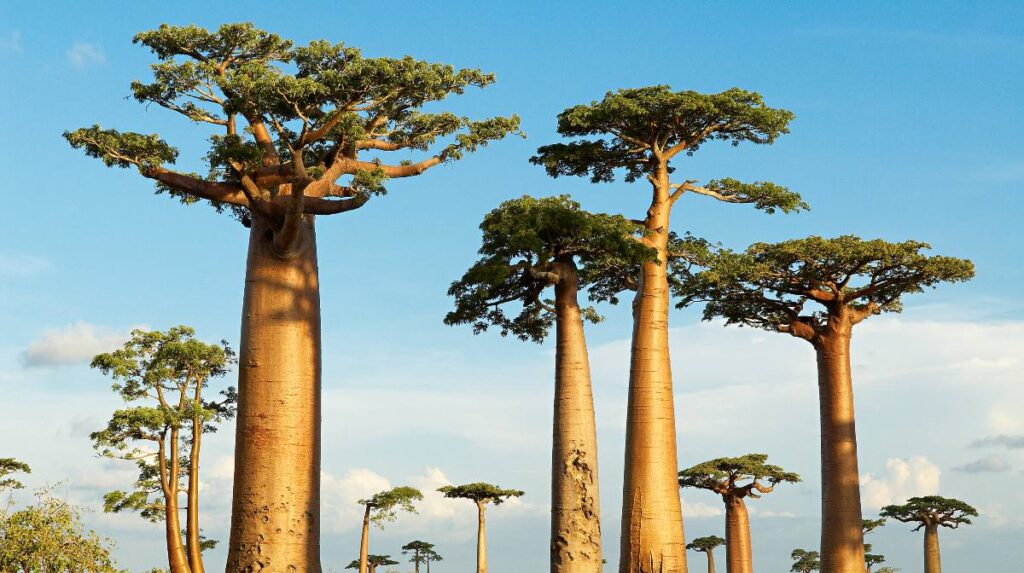
Malawi has a great diversity of vascular plants, with a total of 3,340 recorded species (according to worldrainforests.com), which places it 62nd in the world. Among the most notable species is the baobab tree, known for its great size and longevity, as well as for its medicinal and nutritional properties.
Tobacco defines Malawi’s resource economy: the leaf provides about 50% of the country’s export earnings, according to the overview of Malawi’s tobacco sector (Wikipedia, with primary sources). Malawi is also one of the world’s largest suppliers of burley tobacco: at one point it accounted for 6.6% of world exports of the leaf and was the seventh-largest supplier globally.
Export agriculture: from burley to tea
Malawi was the world leader in burley tobacco production around 2010, but its second pillar is tea. The country is Africa’s second-largest tea exporter by volume, behind Kenya, with sales of $76.1 million in 2023 and between 8% and 9% of the nation’s foreign exchange earnings (TeaTrade, 2024). Tea is the country’s largest formal employer, with more than 120,000 workers.
Lake Malawi: unrivaled endemic fish
Lake Malawi is home to about 1,000 fish species (more than any other lake on the planet), including more than 350 cichlid species, almost all of them endemic to its waters (Lake Malawi National Park, Wikipedia, citing Turner et al. 2001). Lake Malawi National Park was inscribed as a UNESCO World Heritage Site in 1984 for this diversity, which has been compared to that of the Galápagos finches for its value to the study of evolution.
Uranium: the Kayelekera mine
The main mineral resource under development is uranium. The Kayelekera mine, which opened in 2009 and was placed on care and maintenance in 2014, restarted in 2025: Lotus Resources announced its first yellowcake on 1 September 2025 (World Nuclear Association). It has reserves of 10.46 million tonnes of ore at an average grade of 0.11% U3O8 (about 11,377 tonnes of contained U3O8) and was designed to produce about 1,493 tonnes a year (Mining Technology). The operation is 85% owned by Lotus Resources and 15% by the Malawian government (Wikipedia).
Frequently asked questions
How important is tobacco to Malawi’s exports? About 50% of export earnings come from tobacco, and Malawian burley once accounted for 6.6% of world exports of the leaf (Wikipedia, with primary sources).
Why is Lake Malawi unique? It holds about 1,000 fish species, more than any other lake in the world, and almost all of its cichlids are endemic; its national park has been a UNESCO World Heritage Site since 1984 (Wikipedia, citing Turner et al. 2001).
Sources used
- Lists of countries by mineral production – Wikipedia
- Forest area (km²) – World Bank
- Forest area (% of land area) – World Bank
- Coal reserves – Worldometers
- Water and agriculture statistics – FAO
- Precipitation (mm) – World Bank
- Environmental Performance Index – Environmental Performance Index
- Bird species – Mongabay
- Amphibian species by country – Mongabay
- Mammal species – Mongabay
- Endemic mammal species – Our World in Data
- Plant species – Mongabay
- Reptile species by country – Mongabay
- Endemic bird species by country – Our World in Data
The World Bank noted in 2023 that Malawi depends on agriculture for more than 80% of its exports, with tobacco, tea and sugar as the main products.
Organizations that protect or study Malawi’s natural resources
- Department of National Parks and Wildlife (DNPW): The national agency that manages Malawi’s parks, reserves and wildlife.
- Ministry of Natural Resources and Climate Change: The ministry that leads natural resource and climate change policy.
- Environmental Affairs Department (EAD): The department that coordinates environmental management and impact assessments.
- Wildlife and Environmental Society of Malawi (WESM): Malawi’s oldest conservation NGO, working in education and research since 1947.
- Lilongwe Wildlife Trust: Malawian foundation working on animal rescue, environmental justice and landscape conservation.
- African Parks (Liwonde and Majete): Organization that manages Liwonde National Park and Majete Wildlife Reserve in Malawi.
Last updated: September 26, 2026
Leave a Reply