

Mexico’s natural resources include minerals, oil and enormous biodiversity: it is the world’s leading silver producer, with mineral resources valued at $240 billion. It produces about 1.94 million barrels of oil a day (2023) and holds internal renewable freshwater resources of 409 km³, along with copper, gold, iron ore and zinc. What are the natural resources of Mexico?
Mexico is a country rich in natural resources, which makes it one of the most biodiverse nations on Earth. Mexico has a great many natural resources of every kind, used for growing food, raising livestock, supplying water, exporting and more.
Table de contenidos
Oil is among the non-renewable natural resources that have shaped the Mexican economy.
Its territory holds a wide variety of ecosystems, from tropical forests to arid deserts, by way of mountains, rivers and coastlines.
Mexico’s natural resources include a great many endemic animal and plant species, as well as major mineral and oil reserves. Exploiting these resources has been central to the country’s economic development, though it has also created environmental and social challenges that need continued attention.
Which natural resources support Mexico’s economy, and where does the country rank in the world? What is the country’s natural wealth? Which minerals are found in Mexico, and how does it compare in the global rankings? How diverse are the plants and wildlife in Mexico?
Renewable resources, which can be restored by natural processes faster than the rate at which they are consumed: these include solar radiation, the tides of the country’s two oceans, wind, hydroelectric power from its many water sources — especially in the south — water when used properly, and its extensive plant and animal life.
Non-renewable resources such as hydrocarbons, metals and minerals.
Examples of Mexico’s main natural resources
Mexico by the numbers: territory and conservation
Area, land use and protected areas, with the reference year for each.
| Land area | 1,943,950 km²2023 |
|---|---|
| Protected land area | 15.3% of the territory2025 |
| Protected marine areas | 22.6% of its waters2025 |
| Forest cover | 33.6% of the territory2023 |
| Agricultural area | 50.7% of the territory2023 |
| Threatened species | 1,899 mammals, birds, fish and plants2022 |
Map of Mexico’s natural resources by region
Mexico is divided into large geographic regions — Northwest, Northeast, West, Central, South and Southeast — each with distinct natural resources.
| Resource | Reserves / Production | Source |
|---|---|---|
| Oil | 1.94 million barrels/day (2023); 21st in reserves | The Global Economy 2023 |
| Silver | world’s No. 1 producer | USGS |
| Minerals (value) | $240 billion | USGS |
| Copper | ~700,000 t (2024); global top 10 | USGS 2025 |
| Coal | 6.5 million t (2020); 24th in the world | USGS |
| Iron ore | 11.3 million t (2019) | USGS |
Oil and gas resources in Mexico
Mexico is one of the world’s leading oil producers. In 2023 its daily oil output stood at around 1.94 million barrels (The Global Economy, 2023).
The country also holds substantial oil reserves, estimated at 9,711,000,000 barrels as of 2022, placing it twenty-first in the global ranking of oil reserves. The main oil-producing region in Mexico is the Campeche Sound, in the Gulf of Mexico.
Despite holding significant natural gas resources, Mexico is a mid-sized producer, with dry natural gas output of 31.3 billion cubic meters in 2024 (EIA). The country sits twenty-second (22nd) in the global ranking of natural gas producers.
Examples of Mexico’s mineral resources
Mexico is estimated to hold mineral resources worth $240 billion. These are mainly metals and minerals such as copper, gold, iron ore and zinc.
In 2020, Mexico produced 6.5 million tonnes of coal, placing it twenty-fourth in the global production ranking for this resource. It also held proven coal reserves of 1,159,998,620 tonnes, about 0.1% of the world’s total, as of 2023. The main coal-producing region in Mexico is the state of Coahuila.
In 2024, Mexico produced around 700,000 tonnes of copper, which places it among the world’s ten largest producers (USGS, 2025). The main copper-producing region in Mexico is the north of the country, specifically the states of Sonora and Zacatecas, where major deposits of this metal are found.
In 2019, Mexico produced about 11.3 million tonnes of iron ore (gross weight, USGS). The main iron-ore-producing region in Mexico is the north of the country, specifically the states of Coahuila and Sonora, where major deposits of this mineral are found.
In 2024, Mexico produced around 6,300 tonnes of silver, which keeps it the world’s leading producer of this metal (USGS, 2025). The main silver-producing region in Mexico is the state of Zacatecas, followed by Chihuahua, Durango and Sonora.
Mexico is the ninth-largest producer of gold worldwide, with output of 100 tonnes in 2020. It also held reserves of gold of 1,400 tonnes that same year. The country’s main mine is Peñasquito, in the state of Zacatecas.
By output, Mexico ranked among the world’s leaders in several metals and minerals in 2019 (USGS):
- Second-largest producer of fluorite.
- Third-largest producer of celestite and sodium sulfate.
- Fifth-largest producer of lead, molybdenum, bismuth and cadmium.
- Sixth-largest producer of diatomite and zinc.
- Seventh-largest producer of barite.
- Eighth-largest producer of salt.
- Ninth-largest producer of copper and gold.
Water resources of Mexico
Mexico held internal renewable freshwater resources of 409 km³ as of 2020, placing it around twentieth worldwide. This resource is fundamental to the development and wellbeing of the population, as well as to agriculture and industry.
Mexico’s two most important rivers are the Rio Grande (Río Bravo) and the Lerma River, while its main lake is Lake Chapala.
Seven rivers — the Grijalva-Usumacinta, Papaloapan, Coatzacoalcos, Balsas, Pánuco, Santiago and Tonalá — account for 65% of surface runoff and 22% of the country’s total area. Most of Mexico’s water resources are in the south of the country.
The country has 653 aquifers, 105 of them over-exploited, 32 with saline soils and brackish water and 18 with saltwater intrusion. It also has 633,000 km of rivers.
77% of Mexico’s rainfall occurs between June and October. An estimated 70% of all rainwater, however, evapotranspires and returns to the atmosphere.
The main water source for Mexicans is groundwater. It accounts for 64% of public water supply and 33% of the water used in farming and livestock, and it is critical for people living in the country’s arid zones.
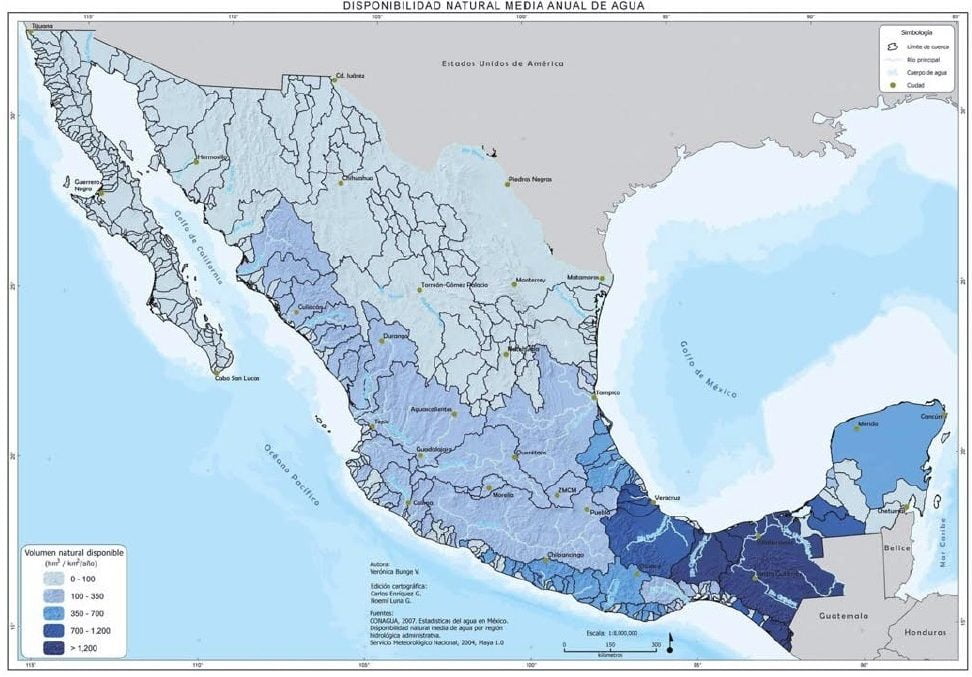
Average rainfall and soils of Mexico
Mexico has average annual rainfall of 758 mm, ranking ninety-third (93rd) worldwide on this indicator. Mexican soils therefore alternate between wetter zones where rain is plentiful and much drier areas where it is scarce.
Renewable electricity and hydropower production in Mexico
In 2025, Mexico generated 82.4 TWh of electricity from renewable sources — 23% of its total generation of 357.0 TWh — and hydropower supplied 28.8 TWh (Ember, 2025). The country’s main hydroelectric plant is the Manuel Moreno Torres Dam, also known as the Chicoasén Dam, in Chiapas, with a generating capacity of 2,430 MW.
Forest resources of Mexico
Mexico has considerable forest wealth, its main forest region being the Sierra Madre Occidental. In 2020 the country’s forest area reached 33.79% of its land area, equivalent to 656,920.8 km².
That places Mexico 11th worldwide for forest area. This natural resource is of great importance to the country, and conserving it is essential to its long-term sustainability.
Environmental performance and protection of Mexico’s natural resources
The country’s Environmental Performance Index (EPI) 2024, Yale University score is 44.2, placing it ninety-seventh (97th) worldwide. One of the measures taken is protected land and marine areas, which account for about 18.91% of total territorial area.
Natural parks of Mexico: the hidden wealth of natural resources
Biodiversity: animal and plant resources of Mexico
Mexico is considered one of the world’s megadiverse countries, its natural wealth far greater than that of most nations. Mexico belongs to a group of 17 countries that together host 70% of the world’s biodiversity.
The country holds a range of very different environments. Mexico has tropical forests, temperate woodlands, mangroves, deserts and scrubland, home to a great many animals and plants. It has around 564 mammal species, 30% of them endemic; 376 amphibian species; 864 reptile species, more than 50% endemic; over 1,000 bird species, 800 cactus species and some 23,000 vascular plant species. Mexico has more plant species than the United States and Canada combined, and more than twice as many as all of Europe.
Many products now central to the world economy originated in Mexico: corn, beans, peppers and tomatoes all come from here, along with cacti, dahlias and poinsettias, among others.
Birds of Mexico
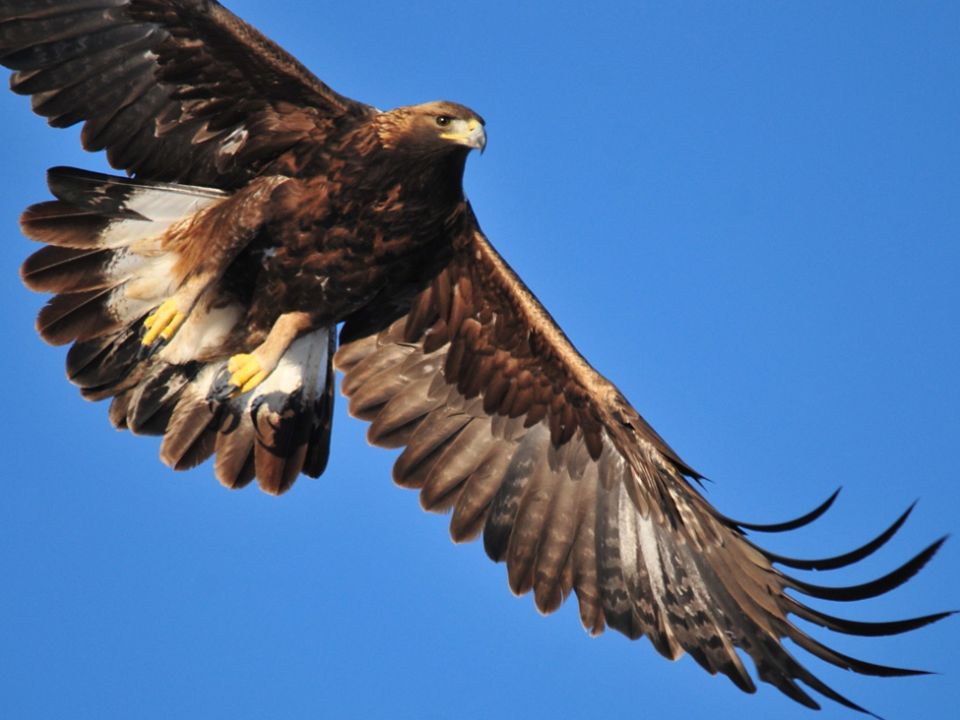
Mexico is a country rich in biodiversity, especially where birds are concerned. With the golden eagle as its flagship species, it has a total of 1,104 bird species, placing it 11th worldwide for avian diversity.
Of those species, 120 are endemic, meaning they are found only in Mexico. However, 71 bird species are endangered.
Fish and amphibians of Mexico
Among its wildlife, Mexico stands out for a notable diversity of amphibians and fish. A total of 376 amphibian species have been recorded, placing it fifth worldwide for number of species of this kind.
It also has a total of 2,624 fish species, making it the tenth country by number of species of this resource. However, 181 of those fish species are threatened.
Among Mexico’s most representative species are the axolotl, an amphibian endemic to the region, and the charal, a fish widely eaten in Mexican cuisine.
Mammals of Mexico
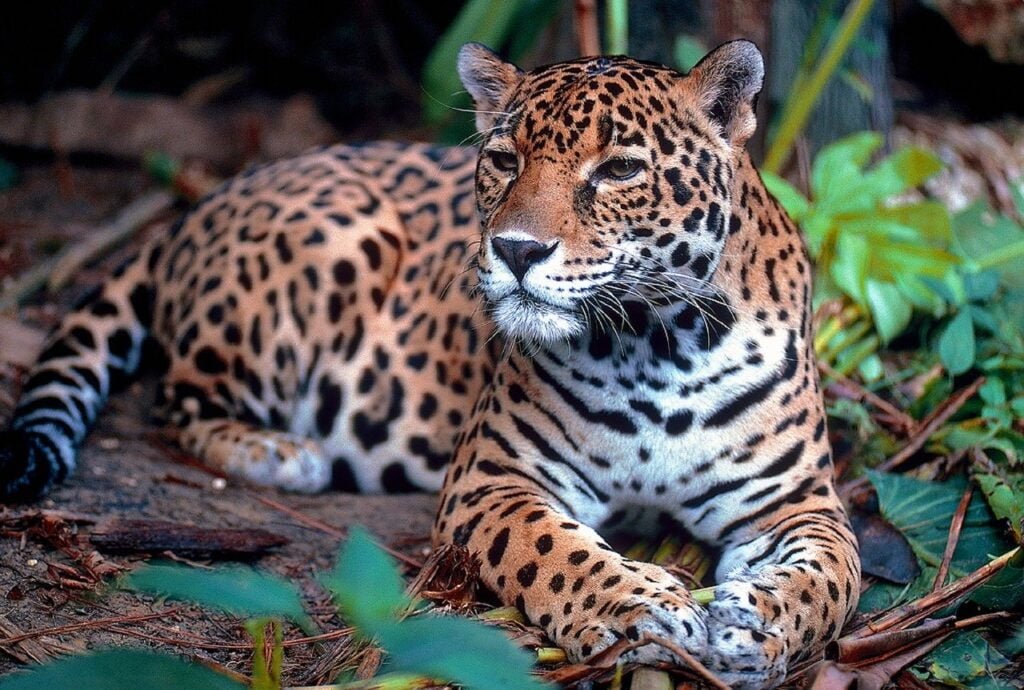
Mexico is a country of great mammal diversity, with a total of 564 species. Of those, however, 96 are threatened.
Mexico ranks third worldwide for number of mammal species, with the jaguar as its flagship species. It also had 152 endemic mammal species as of 2020, placing it fifth worldwide for this natural resource.
Reptiles of Mexico
Mexico is a country of great reptile diversity, with a total of 864 species, placing it second worldwide for number of species. The iguana stands out among them.
Plants of Mexico
Mexico has great vascular plant diversity, with a total of 23,385 species recorded in 2020, placing it fifth worldwide for number of species. The country’s flagship plant is corn, cultivated by Indigenous peoples for thousands of years and a cornerstone of Mexican culture and cuisine.
Organizations that protect or study Mexico’s natural resources
- Greenpeace Mexico – Campaigns for the protection of the environment and human rights.
- Carlos Slim Foundation – Promotes nature conservation and sustainable development.
- SEMARNAT – Mexico’s Ministry of the Environment and Natural Resources.
- WWF Mexico – Works on biodiversity conservation and the sustainable use of natural resources.
- CONANP – Conserves and protects Mexico’s protected natural areas.
Related reading
Climate change in Mexico
Sustainable development in Mexico
Mexico leads the world in silver production and is one of the planet’s 17 megadiverse nations — two features that define the profile of its natural resources in North America.
Silver: the world’s leading producer
Mexico extracted 6,300 tonnes of silver in 2024, almost double the 3,300 tonnes of China, the second-largest producer USGS, 2025. The country has held the global lead in this metal for decades.
Biological megadiversity
Mexico is part of the group of 17 megadiverse countries, which together hold close to 70% of the planet’s species CONABIO. Its world ranking by taxonomic group reflects that concentration CONABIO:
- Second worldwide for reptiles, with 864 species.
- Third worldwide for mammals, with 564 species.
- Fifth worldwide for vascular plants and for amphibians, the latter with 376 species.
Oil in structural decline
Oil and liquids production has held steady at close to 1.9 million barrels per day since 2019, after the peak of 3.9 million barrels per day recorded in 2004 EIA, 2024. Hydrocarbons remain a central resource for the national economy.
Forest cover
Forests covered 33.6% of Mexican territory in 2023 World Bank, 2023. That area supports much of the country’s biological diversity.
Frequently asked questions
Where does Mexico rank in silver production? First in the world, with 6,300 tonnes extracted in 2024, against China’s 3,300 tonnes USGS, 2025.
Why is Mexico considered a megadiverse country? Because it is one of the 17 megadiverse nations, ranking second worldwide for reptiles and third for mammals CONABIO.
Sources used
- Annex: Countries by mineral production – Wikipedia
- Economic data by country – The Global Economy
- Forest area as a percentage – World Bank
- Mexico’s oil reserves – The Global Economy
- Forest area (km²) – World Bank
- Coal reserves – Worldometers
- Water and agriculture statistics – FAO
- Precipitation (mm) – World Bank
- Environmental Performance Index (EPI) 2024 – Yale University
- Bird species – Mongabay
- Amphibian species by country – Mongabay
- Mammal species – Mongabay
- Plant species – Mongabay
- Reptile species by country – Mongabay
- Agua.or.mx
- Business Insider
- AZO Mining
- Natural gas, Wikipedia
- Oil, Wikipedia
Last updated: September 26, 2026
Leave a Reply