


Brazil’s natural resources span oil, minerals, water and enormous Amazonian biodiversity. The country produced roughly 3.36 million barrels of crude oil per day in 2024, its highest level ever thanks to the pre-salt fields, and it is the largest oil producer in Latin America as well as the world’s second-largest iron ore producer. Which natural resources in Brazil matter most?
Brazil is a South American country with an extraordinary wealth of natural resources. From the Amazon rainforest to the white-sand beaches of the Atlantic coast, Brazil holds a vast range of ecosystems and biodiversity.
Table de contenidos
It also has an abundance of rivers, lakes and waterfalls, along with vast stretches of arable land and a rich agricultural output. Brazil’s natural resources are central to the country’s economy and to its sustainable development.
Which natural resources are abundant in Brazil, and where does the country rank worldwide? What natural wealth does the country hold? Which minerals are available, and how does Brazil rank globally? How much water is there, and how is it used to generate power?
Natural Resources
Natural resources are materials or energy sources provided by or found on Earth that are useful to humans. Every product we manufacture is made up of natural resources.
- Renewable resources: these can be restored by natural processes faster than the rate at which they are consumed. Examples include solar radiation, wind, hydroelectric power, water when used properly, and plant and animal life.
- Non-renewable resources: once extracted, these are depleted and cannot regenerate. Examples include hydrocarbons, metals and minerals.
Examples of Brazil’s main natural resources
What Brazil’s subsoil is worth
Economic weight of the country’s natural wealth and the conservation status of its territory.
| Total natural resource rents | 7.9% of GDP2021 |
|---|---|
| Oil rents | 2.6% of GDP2021 |
| Mineral rents | 4.5% of GDP2021 |
| Forest cover | 59.0% of the territory2023 |
| Protected land area | 30.6% of the territory2025 |
| Land area | 8,358,140 km²2023 |
Map of Brazil’s natural resources by region
Brazil is divided into five broad regions — North, Northeast, Central-West, Southeast and South — each with distinct natural resources.
| Resource | Reserves / Production | Source |
|---|---|---|
| Oil | 3.36 million barrels/day (2024); 15th in reserves | Worldometers |
| Iron ore | 405 million t (2019); 2nd in the world | USGS |
| Coal | 6.2 million t (2020); 25th in the world | USGS |
| Aluminum | 659 thousand t (2018); 14th in the world | USGS |
| Natural gas | 22.1 billion m³ (2024); 30th in the world | EIA |
Oil and gas resources in Brazil
Brazil is one of the world’s leading oil producers, with daily crude output of about 3.36 million barrels in 2024 — its highest level yet, driven by the pre-salt fields — which keeps it the largest producer in Latin America (Worldometers). It also holds substantial oil reserves, estimated at 16,184,100,000 barrels as of 2022, placing it fifteenth in the global ranking of oil reserves.
The main oil-producing region in Brazil is the Santos Basin, off the coasts of the states of Rio de Janeiro, São Paulo, Paraná and Santa Catarina. Brazil is a country rich in natural resources, which makes it an important player in the global energy market.
Despite holding significant natural gas resources, Brazil is a mid-sized producer, with dry natural gas output of 22.1 billion cubic meters in 2024 (EIA). The country sits thirtieth (30th) in the global ranking of natural gas producers.
Examples of Brazil’s mineral resources
Brazil produced 6.2 million tonnes of coal in 2020, placing it twenty-fifth in the global production ranking for this resource. It also held coal reserves of about 6.6 billion tonnes in 2023, equivalent to 0.57% of the world’s coal reserves. The main coal-producing region in Brazil is the south of the country, particularly the states of Santa Catarina and Rio Grande do Sul.
In 2018, Brazil produced a total of 659 thousand tonnes of aluminum, placing it fourteenth in the global production ranking for this resource. The main aluminum-producing region in Brazil is the North, specifically the state of Pará, home to the country’s largest bauxite mine — the raw material for aluminum production.
In 2019, Brazil produced a total of 405 million tonnes of iron ore, placing it second in the global production ranking for this resource. The main iron-ore-producing region in Brazil is the state of Minas Gerais, which holds major deposits of this mineral.
Brazil is a significant producer of gold, with output of 80 tonnes in 2020 and reserves of 2,400 tonnes. It ranks fourteenth in the global production ranking for gold.
Water resources of Brazil
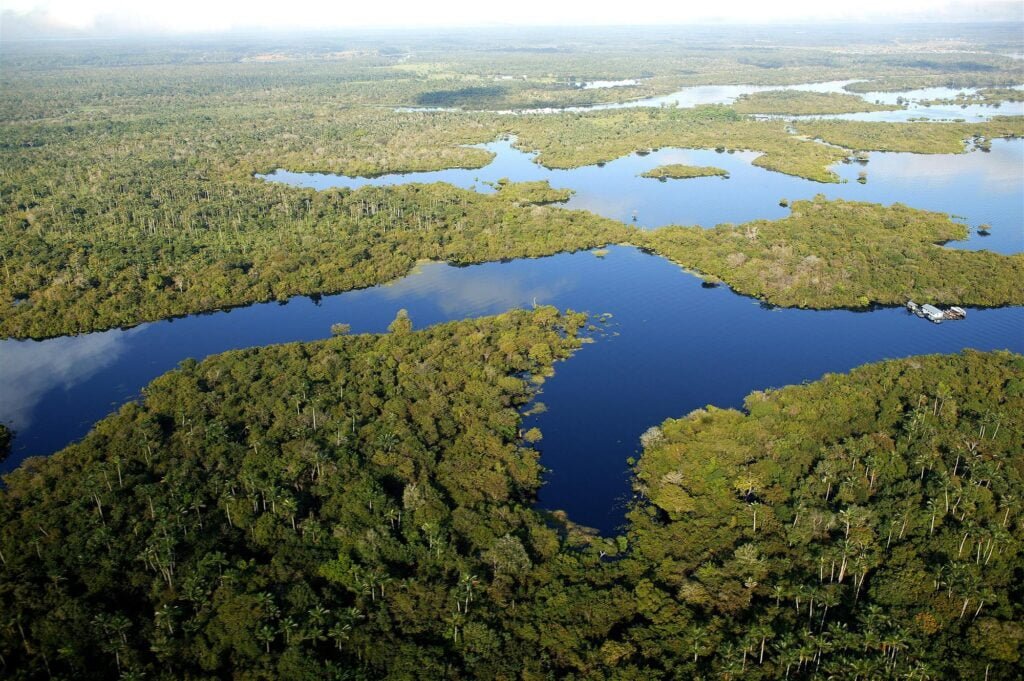
Brazil holds an impressive freshwater reserve of 8,233 km³, placing it first in the global ranking of water reserves as of 2020.
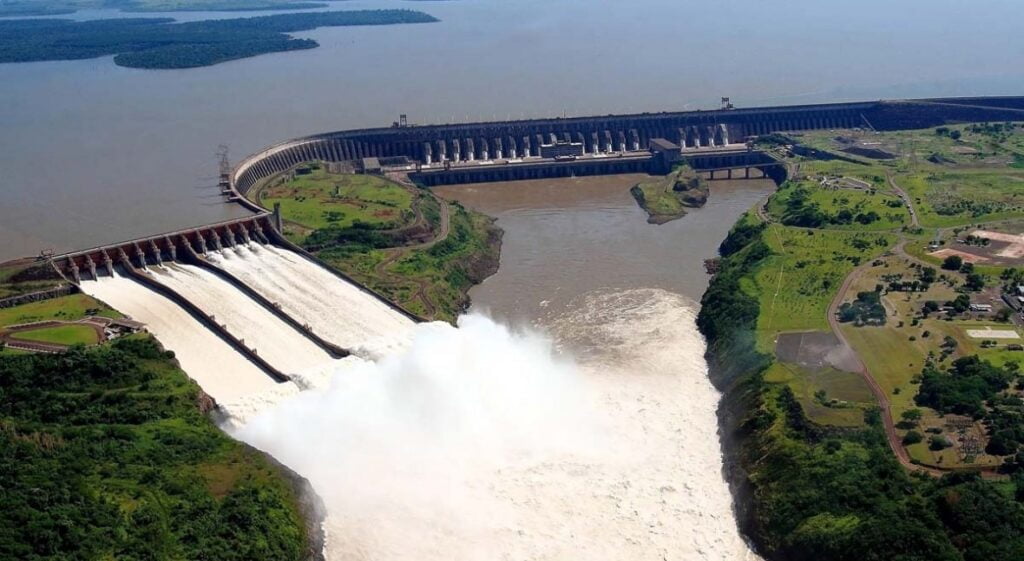
Brazil also has a great many rivers and lakes, the most important being the Amazon River and the Paraná River, along with the reservoir of the Itaipú hydroelectric dam.
Average rainfall and soils of Brazil
Brazil has average annual rainfall of 1,761 mm, placing it thirty-seventh in the global ranking for average annual precipitation. Brazil’s soils vary with the country’s actual humidity: wetter, more fertile soils are found in areas of high rainfall, while drier, less fertile soils occur where rainfall is lower.
Renewable electricity and hydropower production in Brazil
Brazil is one of Latin America’s leaders in renewable energy production, generating 650.0 TWh of renewable electricity in 2025 — 87% of its total generation of 750.5 TWh — with hydropower alone supplying 388.6 TWh (Ember, 2025). The country’s main source of hydroelectric power is the Itaipú plant on the border between Brazil and Paraguay, which set its annual output record of 103.1 TWh in 2016 and generated 83.9 TWh in 2023 (Itaipu Binacional).
It is one of the largest plants in the world and supplies around 10% of the electricity consumed in Brazil.
Forest resources of Brazil
Brazil is known as one of the countries with the greatest forest resources in the world. Its main forest region is the Amazon, which covers much of the country’s forested area.
According to 2023 data, Brazil’s forest area covers 58.98% of its land area, equivalent to 4,929,788 km² — a decline on previous years because of deforestation in the Amazon (World Bank). That places Brazil second in the global ranking for forest area.
Environmental performance and protection of Brazil’s natural resources
Brazil holds a great diversity of natural resources. On the Environmental Performance Index (EPI 2024, Yale University), the country scored 53.0 and ranked 47th out of 180 countries. Protected land and marine areas account for 29.26% of the country’s total territorial area.
Natural parks of Brazil: the hidden wealth of natural resources
Biodiversity: animal and plant resources of Brazil
Birds of Brazil
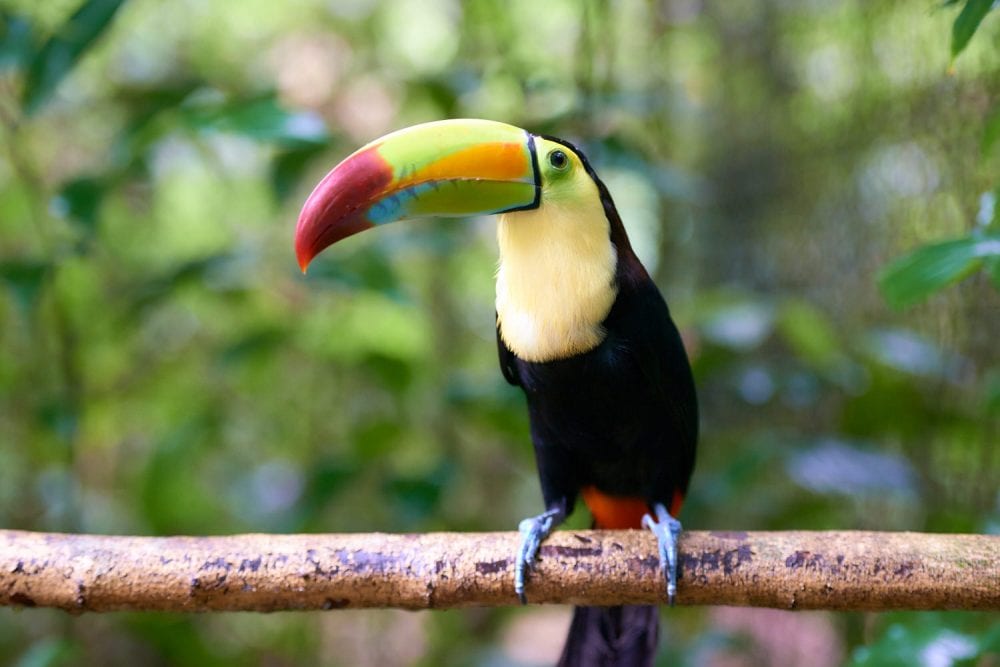
Brazil is a country of great bird diversity, with 1,813 species in total, placing it third worldwide for number of bird species. It also has 254 endemic species, meaning they are found nowhere else.
It is worth noting, however, that 175 bird species are endangered, so protecting this valuable natural resource matters. Among Brazil’s most emblematic species is the toucan, a colorful, striking bird that has become a symbol of Brazilian wildlife.
Fish and amphibians of Brazil
Brazil is a country of great animal diversity, standing out particularly for amphibians and fish. In 2019 a total of 1,022 amphibian species were recorded, making it the country with the most amphibian species in the world.
It also has a total of 4,521 fish species, ranking third worldwide. That said, 93 fish species were recorded as threatened.
Mammals of Brazil
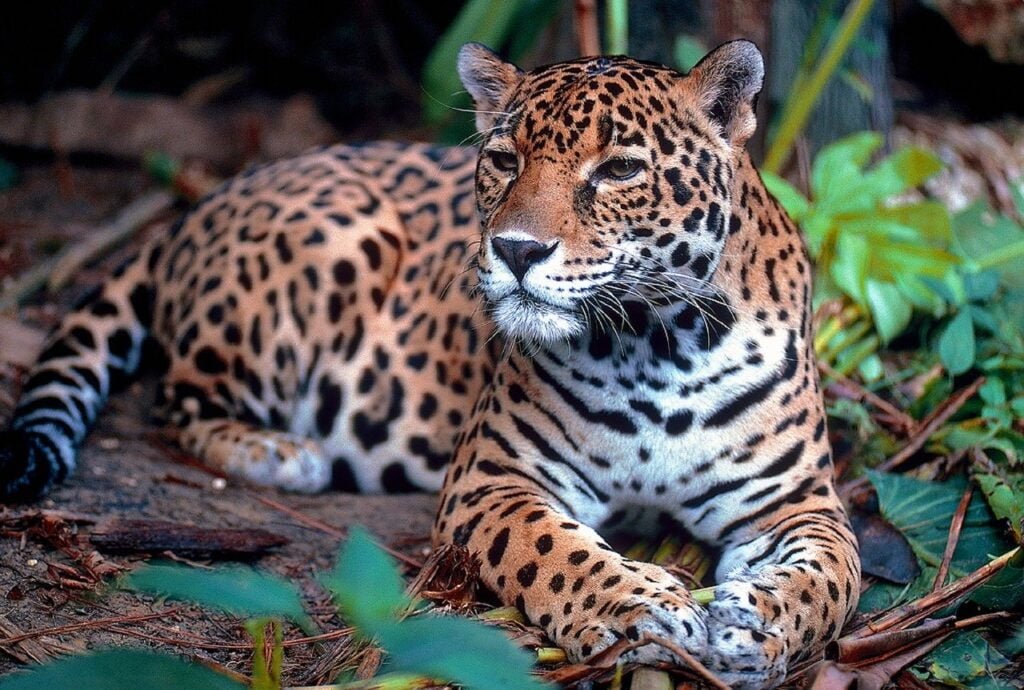
Brazil is a country of great mammal diversity, with a total of 648 species as of 2016, placing it second worldwide for number of species. Of those species, however, 80 are threatened, which makes this an at-risk resource for the country.
Brazil also had 203 endemic mammal species as of 2020, ranking it fourth worldwide for endemic mammals. The country’s flagship mammal is the jaguar, a big cat threatened by poaching and the loss of its natural habitat.
Reptiles of Brazil
Brazil is a country of great reptile diversity, with a total of 814 species as of 2019, placing it third worldwide for number of species. This natural resource matters to the country’s biodiversity, and its flagship species is the jacaré-de-papo-amarelo, a caiman that lives in the rivers and lagoons of the region.

Plants of Brazil
Brazil is the country with the most vascular plant species in the world, with a total of 34,387 species recorded in 2020. That diversity comes from its vast territory and tropical climate, which favor the growth of a wide variety of plants.
The country’s national tree is the pau-brasil (brazilwood), endemic to the Atlantic Forest.
Organizations that protect or study Brazil’s natural resources
- IBAMA – Brazilian Institute of the Environment and Renewable Natural Resources: protects and regulates the sustainable use of natural resources.
- WWF Brazil – World Wide Fund for Nature: works on conserving Brazilian biodiversity and ecosystems.
- SOS Mata Atlântica Foundation – Promotes the conservation and restoration of Brazil’s Atlantic Forest.
- ICMBio – Chico Mendes Institute for Biodiversity Conservation: manages protected areas and species conservation.
- Greenpeace Brazil – International organization campaigning against deforestation and promoting renewable energy in Brazil.
- Conservation International Brazil – Works to protect biodiversity and critical ecosystems in Brazil.
- The Nature Conservancy Brazil – Global organization promoting ecosystem conservation and restoration in Brazil.
Brazil accounts for roughly 90% of world niobium production and around 98% of the metal’s known reserves, according to USGS data for 2025 (Legal 500 citing USGS, 2025). No other country holds an equivalent position in a strategic mineral. Added to that singular position is the largest expanse of tropical rainforest on the planet, the Amazon, whose condition is tracked through official deforestation series.
Mining: near-monopoly niobium and world-class iron ore
Niobium defines Brazil’s mining profile. National output is equivalent to roughly 90% of annual world supply, and domestic reserves represent close to 98% of the known total (Legal 500 citing USGS, 2025). The mineral is used in high-strength steels and alloys.
Iron ore supplies the volume. Brazil is the world’s second-largest producer of iron ore, with 16.7% of global output in 2024, reaching 437.2 million tonnes in 2025 (Mining Technology, 2025).
- Vale produced 336.1 million tonnes in 2025, or 76.9% of the national total (Mining Technology, 2025).
- Australia and Brazil dominate world iron ore exports, with close to a third of the total each (USGS, 2025).
Amazon: deforestation measured by PRODES is falling
Deforestation in the Legal Amazon totaled 5,796 km² in the twelve-month period ending July 31, 2025, down from 6,518 km² a year earlier — an 11% drop (Mongabay citing INPE/PRODES, 2025).
It is the lowest annual figure since 2014, according to the PRODES satellite system run by the National Institute for Space Research (Mongabay citing INPE/PRODES, 2025). The indicator measures cumulative clear-cutting between August and July.
Wildlife and flora: the scale of the official species assessment
The revision of the national list of threatened species — the first since 2014 — assessed 8,537 animal species and 7,524 plant species (Fiocruz Biodiversidade citing Portaria MMA 148/2022).
The update added 3,209 plant species to the threatened list, an increase of more than 50% on the previous version (Apremavi citing MMA, 2022). The work was carried out between 2015 and 2021 by ICMBio and the Rio de Janeiro Botanical Garden.
Electricity mix: hydropower dominates
86% of Brazil’s electricity generation comes from low-emission sources, with hydropower supplying more than half the total in the rolling twelve-month period ending April 2026 (Low Carbon Power, 2026).
- Wind and solar combined supply almost a quarter of the country’s electricity (Low Carbon Power, 2026).
- Fossil fuels account for about 14% of generation (Low Carbon Power, 2026).
- Carbon intensity stands at 114 gCO2eq/kWh (Low Carbon Power, 2026).
Garimpo: illegal mining in Indigenous territories
Mapping by the Amazon Network of Georeferenced Socio-Environmental Information identified at least 2,312 sites and 245 areas of unauthorized mineral extraction across the Pan-Amazon (RAISG, 2018).
Of 6,207 Indigenous territories, 78 recorded mining activity and 37 had garimpo inside their boundaries; Brazil led with 18 of those 37 cases (RAISG, 2018). Of 649 protected areas, 55 had active sites within their borders.
Frequently asked questions
Where does Brazil rank in world niobium production?
Brazil produces roughly 90% of the world’s niobium and holds around 98% of known reserves, according to USGS data for 2025 (Legal 500 citing USGS, 2025).
Is deforestation in the Amazon rising or falling?
Falling. The period ending in July 2025 recorded 5,796 km², 11% less than the previous period and the lowest level since 2014, according to PRODES (Mongabay citing INPE/PRODES, 2025).
How much of Brazil’s electricity comes from low-emission sources?
86% of generation comes from hydropower, wind, solar, biofuels and nuclear, with hydropower alone above half the total (Low Carbon Power, 2026).
Sources used
- Lists of countries by mineral production
- Economic data by country
- Forest area (km²)
- Forest area as a percentage
- Arable land area (km²)
- Oil reserves
- Coal reserves
- Water and agriculture statistics
- Precipitation (mm)
- Environmental performance index
- CO2 emissions (metric tonnes per capita)
- Bird species
- Amphibian species by country
- Mammal species
- Endemic mammal species
- Plant species
- Reptile species by country
- Endemic bird species by country
Last updated: September 26, 2026
Leave a Reply