


Madagascar’s natural resources are celebrated for unparalleled biological endemism, global agricultural leadership producing 42% of the world’s vanilla, and 336 km³ of freshwater reserves (27th globally). With 213 endemic mammal species (led by over 100 lemur varieties), 454 reptile species, 11,832 vascular plants, and the major Ambatovy nickel-cobalt mine, Madagascar is a global conservation priority.
Madagascar, the world’s fourth-largest island located off the southeastern coast of Africa in the Indian Ocean, is renowned for its incomparable ecological richness. Spanning 587,041 km², the island evolved in geographic isolation for over 80 million years, creating a living laboratory of evolutionary biology. As part of our regional survey of Africa natural resources and our global directory of natural resources by country, this report evaluates Madagascar’s natural heritage.
Table de contenidos
The island possesses diverse natural resources, including strategic minerals such as nickel, cobalt, and chromium, extensive agricultural lands producing cash crops like vanilla and cloves, and critical river basins. Yet severe deforestation, slash-and-burn agriculture (tavy), and soil erosion pose acute challenges to long-term sustainability.
What is the full scope of Madagascar’s natural resources? How are its soils, forests, and freshwater reserves distributed? What makes its flora and fauna among the most irreplaceable on Earth?
Key Fact: Natural Resources
Natural resources are materials or energy sources provided by nature and found on Earth that are useful to humanity. Every manufactured product is built from natural resources.
- Renewable natural resources: these can be restored by natural processes faster than the rate of consumption. Examples include solar radiation, wind, hydroelectric power, properly managed water, and plant and animal biomass. For comparative dynamics, see our guide to renewable vs non-renewable resources.
- Non-renewable natural resources: once extracted, these finite reserves are depleted and cannot regenerate on a human timescale. Examples include hydrocarbons, coal, and metallic minerals. For full classifications, explore our guide to types of natural resources.
Examples of Madagascar’s Main Natural Resources
Madagascar in Figures: Territory and Conservation
Surface area, land use distribution, and protected areas with baseline years.
| Land area | 581,800 km²2023 |
|---|---|
| Protected land area | 12.8 % of the territory2025 |
| Marine protected areas | 1.4 % of territorial waters2025 |
| Forest cover | 21.3 % of the territory2023 |
| Agricultural land | 70.3 % of the territory2023 |
| Threatened species | 3,191 mammals, birds, fish and plants2022 |
Water Resources of Madagascar
Madagascar possessed a renewable freshwater reserve of 336 km³ in 2020, positioning it 27th in the world for national freshwater resources.
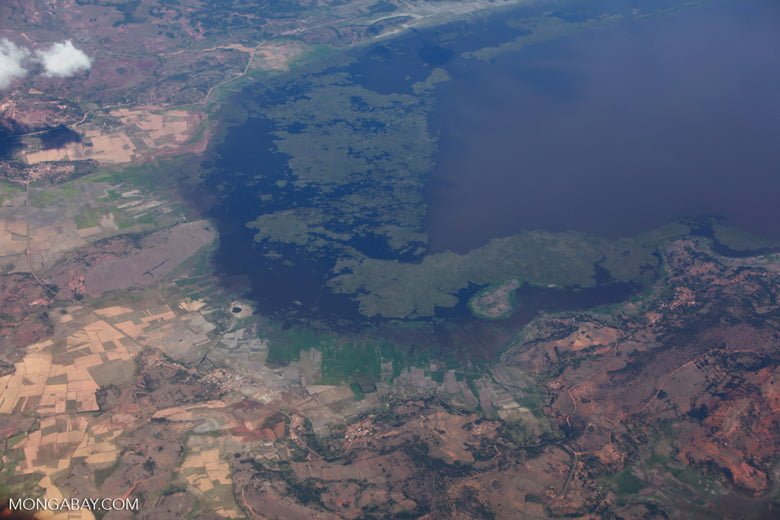
The island’s hydrological network is defined by major western river systems like the Mangoky and Betsiboka, alongside Lake Alaotra—the largest natural lake in Madagascar, which anchors the country’s primary rice-growing plains. Learn more in our global guide to water resources.
Average Precipitation and Soils of Madagascar
Madagascar receives an average annual precipitation of 1,513 mm, ranking 49th globally in rainfall. Precipitation patterns exhibit dramatic geographic contrast: the eastern escarpment receives heavy tropical moisture nurturing rainforests, while the southwestern region experiences semi-arid conditions dominated by spiny thickets. Intense tropical weathering produces the island’s characteristic red ferrallitic soils, earning Madagascar its historical moniker ‘The Red Island.’
Forest Resources of Madagascar
Madagascar’s forests represent an irreplaceable global biological reservoir. In 2020, forest cover stood at 21.36% of its land area, spanning approximately 124,298 km².
This ranks Madagascar 45th globally in total forest surface area. However, deforestation driven by slash-and-burn clearing (tavy) and illegal logging of precious rosewood and ebony represents an ongoing conservation crisis. Explore international forest conservation in our guide to forest resources.
Environmental Performance and Resource Protection in Madagascar
Madagascar’s exceptional biodiversity faces intense ecological pressures. On the Environmental Performance Index (2024), Madagascar scored 30.1, ranking 173rd out of 180 nations (EPI 2024). Terrestrial and marine protected areas account for 5.1% of the country’s total territorial area (World Bank, 2025), highlighting the vital need for reinforced conservation governance.
National Parks of Madagascar: The Hidden Wealth of Natural Resources
Biodiversity: Animal and Plant Resources of Madagascar
Birds of Madagascar
Madagascar possesses 278 recorded bird species, holding a distinctive place in global avifaunal studies (birds – worldrainforests).
Of these, 119 are endemic—occurring strictly nowhere else on Earth. However, 37 bird species are currently threatened with extinction.
Notable species include the Madagascar paradise flycatcher (Terpsiphone mutata), celebrated for its iridescent crest and long flowing tail streamers.
Fish and Amphibians of Madagascar
Madagascar hosts sensational amphibian diversity, with 412 recorded amphibian species—nearly 100% of which are strictly endemic to the island (amphibians – worldrainforests).
In aquatic ecosystems, 1,253 fish species have been documented, placing the island among the most diverse marine and estuarine environments globally (fish – worldrainforests). However, 111 fish species are classified as threatened.
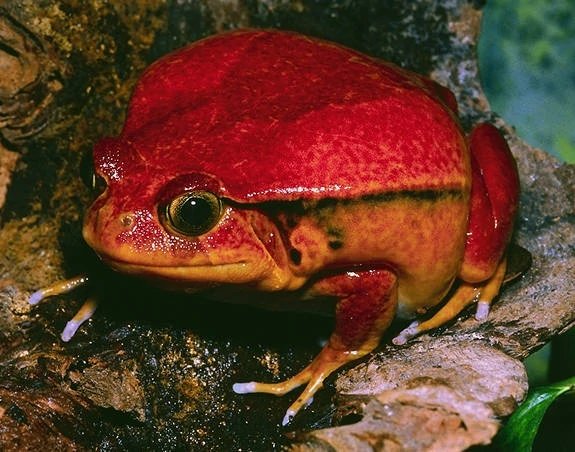
Flagship species include the tomato frog (Dyscophus antongilii) and endemic freshwater Malagasy cichlids.
Mammals of Madagascar
Madagascar’s mammalian fauna is one of the crown jewels of world biogeography. With 257 recorded mammal species—of which 121 are under extinction threat—the island presents both unmatched uniqueness and acute vulnerability (mammals – worldrainforests).
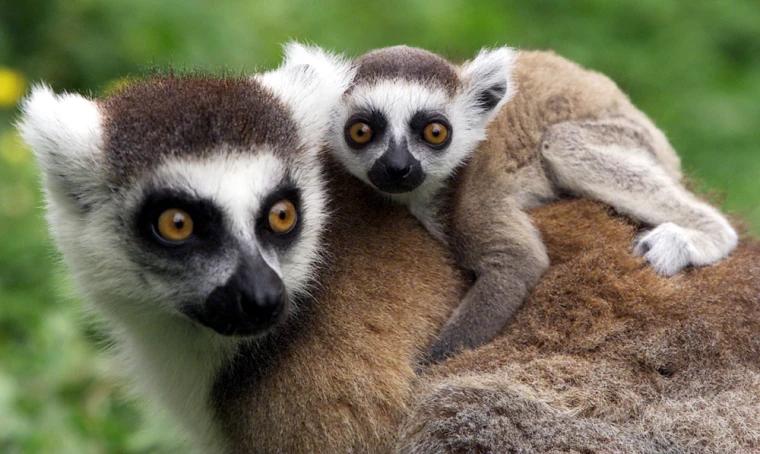
Furthermore, Madagascar boasts 213 endemic mammal species, ranking 3rd in the entire world for endemic mammals. Foremost among them are lemurs, an entire primate infraorder found exclusively in Madagascar.
Reptiles of Madagascar
Madagascar supports outstanding reptile richness, counting 454 reptile species, ranking among the world’s most diverse herpetological regions (reptiles – worldrainforests). Over 90% of these reptiles are endemic, with chameleons—including about half of the world’s known chameleon species—serving as iconic representatives.
Plants of Madagascar
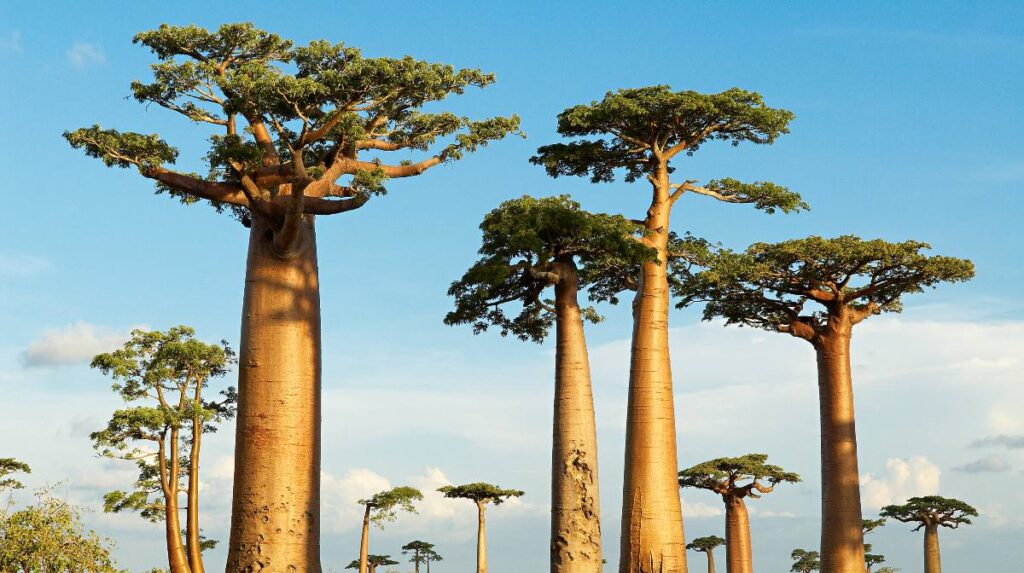
Madagascar is home to 11,832 vascular plant species, placing it among the highest botanical concentrations worldwide (plants – worldrainforests). The most iconic botanical landmark is the baobab (Adansonia): six of the world’s eight baobab species are endemic to Madagascar, growing up to 30 meters tall.
Organizations Protecting or Studying Madagascar’s Natural Resources
- WWF Madagascar: Champions biodiversity conservation and community-led sustainable development across Madagascar.
- Conservation International Madagascar: Protects critical forest ecosystems and supports natural capital accounting.
- Blue Ventures: Pioneers marine conservation and locally managed marine areas (LMMAs) in coastal Madagascar.
- Lemur Conservation Network: Unites over 60 conservation agencies to protect lemurs and their forest habitats.
Madagascar is the world’s premier producer of natural vanilla: in 2023 it accounted for 42% of global production—harvesting 3,113 of the 7,433 recorded tonnes worldwide—ahead of Indonesia (25%), according to FAOSTAT figures cited in the cultivation review (Wikipedia, citing FAOSTAT, 2023). This cured orchid pod is the island’s single most valuable agricultural export.
Bourbon Vanilla: The Crop Driving Agricultural Exports
Malagasy vanilla is of the Bourbon variety (Vanilla planifolia) and forms the backbone of the rural export economy in northeastern regions like Sava. Together, Madagascar and Indonesia supply roughly two-thirds of global natural vanilla. Cultivation is exceptionally labor-intensive, requiring hand-pollination of every single flower during morning blooms.
Nickel and Cobalt: The Ambatovy Project
The country’s flagship mining operation is Ambatovy, one of the world’s largest lateritic nickel and cobalt projects. Engineered to produce 60,000 tonnes of refined nickel and 5,600 tonnes of refined cobalt annually, the deposit holds proved and probable reserves of 152.1 million tonnes with an estimated mine life of at least 29 years (NS Energy). Ownership is held by Japan’s Sumitomo Corporation (54.18%) and South Korea’s KOMIR (45.82%) (Wikipedia). Explore our guide to global mineral resources for details on critical battery metals.
Endemism: Species Found Nowhere Else on Earth
Separated from continental landmasses for tens of millions of years, Madagascar evolved an incomparable biosphere. Over 80% of its plant species are found nowhere else on the planet (Callmander et al., 2011), while more than 90% of its native reptile species are strictly endemic (Wikipedia, citing Okajima and Kumazawa, 2009). The island also exclusively harbors all 107 known lemur species, a primate infraorder endemic to Madagascar.
Sources Used
- Forest Area (km²) – World Bank
- Forest Area as Percentage of Land – World Bank
- Water and Agricultural Statistics – FAO AQUASTAT
- Average Precipitation (mm) – World Bank
- Environmental Performance Index – Yale Center for Environmental Law & Policy
- Bird Species Richness – Mongabay
- Amphibian Species by Country – Mongabay
- Mammal Species Richness – Mongabay
- Endemic Mammal Species by Country – Our World in Data
- Vascular Plant Species – Mongabay
- Reptile Species by Country – Mongabay
- Endemic Bird Species by Country – Our World in Data
According to data updated to 2025, Madagascar remains the world’s undisputed leading producer of vanilla, generating around 42% of global supply, as well as a leading exporter of cloves, making the island a globally critical ecological hotspot.
Last updated: September 26, 2026
Leave a Reply