

It is hard for consumers to tell whether a product is truly sustainable, because many companies exaggerate or lie about its environmental benefits. One example is Volkswagen, which promoted its diesel cars as greener while, as revealed in 2015, it had rigged the engine software of about 11 million vehicles to cheat emissions tests. Looking for seals or certifications from trustworthy institutions helps. How can you tell whether a product is sustainable?
What is a sustainable product? Who decides whether a product is sustainable or not?
Contents
For the average consumer, it is hard to tell whether the goods or services companies offer are really sustainable. Marketing campaigns can lead us to believe that we are indeed buying products that bring us closer to sustainable development, but the truth is that many of these claims are exaggerated or poorly supported: a 2020 European Commission study of environmental claims in the EU found that 53.3% gave vague, misleading or unfounded information and 40% were unsubstantiated. Some companies also market their products as eco-friendly by citing environmental benefits that are mostly exaggerated, or simply by lying about the product’s qualities.
It is common for companies to create their own definitions of sustainable products and to present themselves as eco-friendly companies to boost sales, often without really being so.

One example of this is the case of Volkswagen, the well-known German carmaker, which came to light in September 2015. While it was promoting its line of diesel cars as a greener alternative, it had fitted about 11 million cars worldwide with engine software that detected emissions tests and switched on the full emission controls only during testing, so it could sell them even though on the road they polluted more than the standards allowed. By June 2020, the scandal had cost Volkswagen $33.3 billion in fines, penalties, settlements and buybacks.
The point is not to accuse every company of dishonest practices. But the truth is that this green marketing strategy has worked, honest or not: we buy more and more products that are marketed as sustainable.
Consumers who care about sustainable development and want to support the companies making this kind of effort face a big challenge, because they can easily be misled. What is more, it is not clear what they should look at: the sustainability of the products or the social responsibility of the companies.
That is why we need to think critically when we are bombarded with information whose goal is to sell us something. We have to stay alert and not take everything at face value. In this regard, it helps to look for seals or certifications granted by trustworthy environmental institutions or associations.
Being smart shoppers has a big influence on the kind of development we achieve as a society. If we support the wrong efforts and encourage fake sustainable development, we are surely on the wrong path.
Truly sustainable products

Some consumer goods are objectively a step toward sustainable development. They do not depend on a specific brand, and often they are not even the product of a technological breakthrough, but their widespread use certainly helps reduce environmental impact. Some examples:
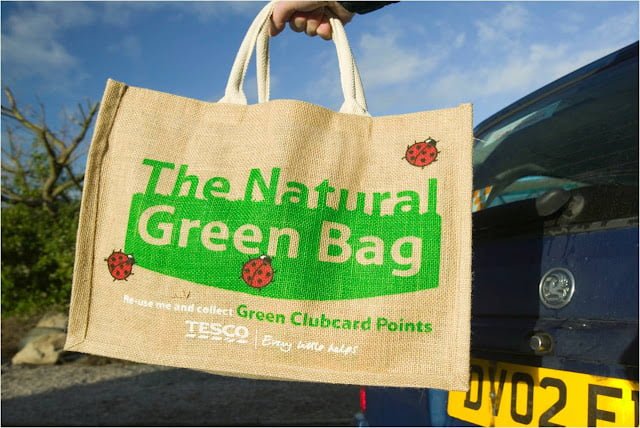
Cloth bags: they replace single-use plastic bags, but they only pay off if reused many times: according to the UK Environment Agency (2011), a cotton bag must be used at least 131 times to have a lower global warming potential than a conventional plastic bag that is not reused.
Rechargeable batteries: they cost more, but they replace regular batteries, which are hard to recycle.
Reusable water bottles: the bottled water sold in stores often comes in plastic designed for a single use, which is thrown away afterward. Glass or metal bottles, on the other hand, can be reused.
LED bulbs: they save energy and last much longer than traditional bulbs, and although they cost more to buy, their price has fallen sharply and they save money in the long run thanks to their low energy use and long life, according to the US Department of Energy.
More: sustainable consumption
The case of clothing and cotton
One case that shows how hard it is for shoppers to know whether a company is socially responsible and its products are sustainable is contract garment manufacturing. To determine whether a brand’s cotton clothing is sustainable, you have to consider many factors about the product’s sustainability, such as the production process, the origin of the raw materials, working conditions and supply chain management.
This includes whether the crop is irrigated with modern techniques such as precision agriculture that reduce water use; whether the fertilizers used pollute water sources; whether pesticides are used that harm the farmers themselves and nearby natural ecosystems; whether rainforests are cleared to grow it, eroding the soil and destroying the habitat of plants and animals; whether forced or child labor is used; and, more generally, whether workers’ rights are violated through discrimination, exposure to hazards, unfair pay or restricted freedom.
But, as we have said, it is impossible for the average shopper to know these things, so the best advice is to look for seals or certifications from trustworthy eco-friendly institutions that guarantee the company is genuinely working toward sustainable development and that it is not just running marketing campaigns.
More:
Sustainable projects
Sustainable actions
A 2023 McKinsey report, prepared with NielsenIQ, found that US consumer products making environmental or social (ESG) claims grew their sales by an average of 28% over five years (2017 to June 2022), compared with 20% for products without such claims.
Last updated: September 26, 2026

Leave a Reply