

Sustainable consumption is the use of products and services with the least possible impact on the environment, also called responsible or conscious consumption. What is sustainable consumption in practice? According to the UN (2011), it seeks to minimize the negative effects of consumption and production while improving quality of life, taking the product’s whole life cycle into account and avoiding the Jevons Paradox.
Consumer behavior is central to humanity’s impact on the environment. The choices we make as consumers have multiple direct and indirect consequences for the natural world and, ultimately, for our own wellbeing and ability to survive.
Contents
Consuming responsibly starts with understanding what renewable natural resources are and how they regenerate.
This article explains what sustainable consumption means, its characteristics, where the idea came from, examples, how to encourage it, and how it relates to sustainable production.
What is sustainable consumption?
Sustainable consumption is the use of products and services that have a minimal impact on the environment and on the ability of future generations to meet their own needs.
Sustainable consumption is also known as responsible consumption or conscious consumption.
Other definitions of sustainable consumption
Sustainable consumption and production is the use of goods and related services that respond to basic needs and bring a better quality of life while minimizing the use of natural resources and toxic materials, so as not to jeopardize the needs of future generations. Oslo Symposium (1994)
Sustainable consumption is a decision-making process that draws both on the consumer’s social responsibility and on their own needs and wants. Meulenberg, M. (2003)
Sustainable consumption is a holistic approach to minimizing the environmental harm caused by consumption and production systems while promoting a better quality of life for all. UN (2011)
Beyond these definitions, a set of key characteristics captures what the concept is trying to achieve.
Characteristics of sustainable consumption
- Sustainable consumption stays within ecological limits. It accepts that resources are finite.
- It meets the needs of everyone in society — at the very least, the basic ones.
- Sustainability, or sustainable economies, cannot be achieved without it.
- It improves quality of life without increasing environmental degradation.
- It shifts consumption patterns toward products and services that need fewer materials and less energy.
- It considers the impacts of every stage of the production and consumption life cycle.
- It avoids the rebound effect, or Jevons Paradox, whereby making a product more efficient ends up increasing how much of it is consumed.
- It favors products made from renewable resources.
- It favors products that generate as little waste and pollution as possible.
Why what we buy decides how much gets extracted
Every object in a store started out as raw material taken from a mine, a field, a forest or a well. Consumption is the visible end of that chain: when millions of people repeat a purchase, the demand travels backward all the way to extraction. UNEP’s International Resource Panel calculates (Global Resources Outlook 2024) that extraction of natural resources tripled in five decades: since 1970, the average person on the planet has gone from using 23 kilograms of materials a day to 39 (IRP-UNEP, 2024).
That extraction and its processing cause 40% of the health damage from air pollution. Biomass alone (crops and forestry) accounts for 90% of land-related biodiversity loss and water stress. And the burden is unequal: low-income countries consume six times less material than high-income ones. That is why SDG target 12.2 calls on the world, by 2030, to “achieve the sustainable management and efficient use of natural resources” (UN, SDG 12). Changing what and how much we consume moves the whole chain.
Worked example for students: cloth bag or plastic bag?
Question: which shopping bag has the smaller carbon footprint? Short answer: it depends on how many times it is used.
- Step 1, the data. In 2011 the Environment Agency of England compared the full life cycle of the supermarket carrier bags available in 2006. To have a lower global warming potential than a lightweight polyethylene (HDPE) bag used only once, a paper bag must be used at least 3 times; a heavy polyethylene (LDPE) bag, 4; a non-woven polypropylene bag, 11; and a cotton bag, 131. If 40.3% of lightweight bags are reused as bin liners, the cotton bag needs 173 uses (Environment Agency, 2011).
- Step 2, the math. A family that shops twice a week uses its bag about 104 times a year (2 × 52). Cotton: 131 ÷ 104 ≈ 1.3 years, about 15 months; in the 173-use scenario, about 20 months. Non-woven polypropylene: 11 ÷ 2 = 5.5 weeks.
- Step 3, the conclusion. A reusable bag only comes out ahead if it is actually reused; left in a drawer, its footprint exceeds that of the lightweight bag. For every bag, the impact is concentrated in raw materials and manufacturing, not in transport or disposal. Limitation: the study did not assess litter, so it answers a climate question, not every question.
Lesson: a product is not sustainable because of its label, but because of how it is used over its whole life, the idea that guides the circular economy proposes.
Sustainable, responsible, conscious consumption: are they the same?
Essentially, yes, but each name stresses something different. If a school exercise asks you to complete “sustainable consumption is also known as … consumption,” the usual answer is responsible or conscious. In Spanish, two words, sostenible and sustentable, both translate “sustainable.”
| Term | What it emphasizes | Guiding question when buying |
|---|---|---|
| Sustainable consumption | Not exceeding ecological limits or taking options away from future generations. In Spanish, the UN uses “consumo y producción sostenibles” (SDG 12). | Could this purchase be repeated for generations? |
| Responsible consumption | Owning the environmental and social consequences of every purchase. | Who pays the cost that does not show up in the price? |
| Conscious consumption | Deciding with information rather than on impulse. | Do I need it, or do I just want it right now? |
| Green or eco-friendly consumption | Products with a lower environmental impact; it covers only part of the concept and lends itself to greenwashing. | Has a third party verified the environmental claim? |
| Ethical or fair consumption | The conditions of the people who produce, as in fair trade. | Was the person who made or grew it paid a fair price? |
| Collaborative consumption | Sharing, renting or swapping instead of owning. | Can I borrow it instead of buying it? |
Where sustainable consumption came from
Why do we consume the way we do today? What shapes our consumption?
Societies have worried about the effects of their actions on ecosystems since antiquity — and have mostly ignored them.
The Industrial Revolution created the first large-scale environmental crises, but it also gave rise to ideas about sustainability in production: in Germany, foresters kept a balance between the timber they felled and the woodland they conserved.
The first half of the 20th century brought new concerns about species loss, but the main preoccupation was still human progress and economic development. Sustainability was discussed in terms of production, not consumption.
The 1960s and 1970s saw the rise of non-governmental environmental organizations. Among other goals, these groups set out to make citizens aware of the environmental consequences of their purchasing decisions.
The UN and several governments also began to worry about environmental problems and how future generations would be affected. A series of international summits agreed on commitments, framed the environmental problems, raised public awareness and produced action plans that partly promoted sustainable consumption. Those summits produced the Millennium Development Goals and, later, the Sustainable Development Goals.
In the UN Sustainable Development Goals (SDGs), Goal 12 calls for sustainable consumption and production. According to 2022 data compiled by the UN, 19% of the food available to consumers was wasted — around 1.05 billion tonnes — which shows how urgent this goal is (UN, SDG 12). More: UN SDGs
Civil society and business have also led campaigns against polluting products and have driven real changes in consumption. Here are some of them.
More: History of sustainable development
More: 8 key facts about the global food system
Examples of sustainable consumption
- Volatile organic compounds were removed from paints. More than 70% of the paint sold today is water-based.
- Synthetic refrigerant gases in fridges and freezers have been phased down.
- Fridges have become more efficient. On average, the least efficient freezer on sale today uses only half the energy of the least efficient freezer on the market eight years ago.
- Newspaper production uses more recycled paper.
- Liquid and capsule detergents are more widely used, cutting the amount consumed and the use of degradable materials.
- Low-energy, longer-life light bulbs have become standard.
More: sustainable products
How to encourage sustainable consumption
Public interest in sustainable consumption is growing, but consumption patterns themselves have barely shifted. In fact, according to UNEP’s Food Waste Index Report 2024, households generated around 60% of the world’s food waste — roughly 79 kg per person per year — a sign that changing everyday habits remains the hardest part (UNEP, 2024).
Our consumption patterns rest on several factors: culture, technology, convenience, ideology, income level and so on. What stands out most, though, is resistance to change.
Researchers and policymakers have therefore proposed a range of mechanisms to make production-consumption systems more sustainable.
Examples of mechanisms and actions for sustainable consumption and production
- Sustainable supply chains. Companies with bargaining power impose green standards on their suppliers.
- Co-design. Consumers take part in developing products with a lower environmental impact.
- Making producers responsible for the final disposal of their products.
- Independent “green” certifications and labels that guarantee good production practices.
- Awareness campaigns focused on the impact of everyday choices and on how to change consumption patterns.
Calculator: how much water does your shower use?
How sustainable consumption and production relate
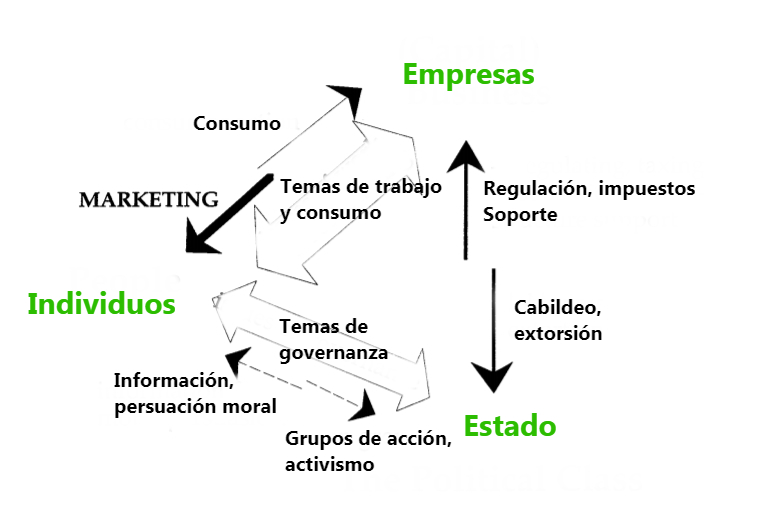
Individuals are the constant target of company marketing, while consumers have only limited influence over firms’ brands, products and technologies.
The state, business and individuals
Governments, for their part, create taxes and regulations that shape what companies produce. A new tax on plastic products, for instance, can push firms to change the materials they use.
At the same time, companies lobby and pressure government for concessions that protect their margins.
In this relationship, companies adjust their products and practices in a greener or more sustainable direction only when government requires it or creates policies that reward the change.
That does not mean individuals are powerless. Government writes rules for business when it feels public pressure to do so. Even then, changes that would seriously dent corporate profits rarely get through.
Companies are built to maximize financial returns. That is why individuals are the only genuine force capable of driving real change toward sustainable consumption and sustainable production.
More: Sustainable companies
Sources and further reading:
GreenGrowthKnowledge (PDF)
Sustainable Food Consumption: Exploring the Consumer “Attitude – Behavioral Intention” Gap
Sustainable Development UN
Last updated: August 19, 2026




Leave a Reply