

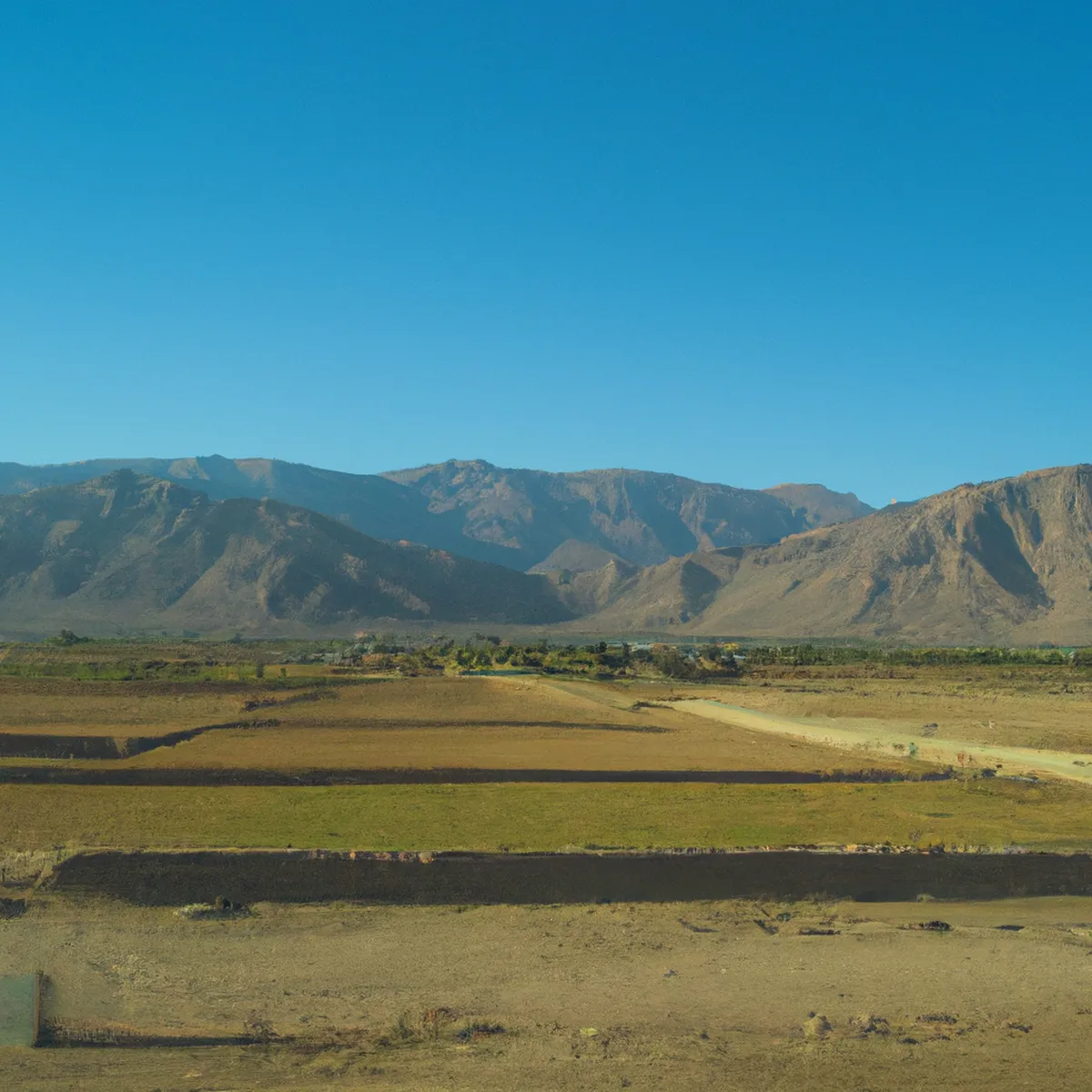
Afghanistan’s natural resources include minerals, hydrocarbons, water and biodiversity. What natural wealth does the country have? Highlights include part of the roughly 1,900 million barrels of undiscovered recoverable oil that the USGS estimates for the Amu Darya and Afghan-Tajik basins, coal reserves of 72.75 million short tons and 5,000 vascular plant species recorded in 2020.
Afghanistan is a country with a large quantity and variety of natural resources, including minerals, fossil fuels, water and biodiversity. These resources have been exploited by various foreign powers throughout the country’s history.
Table de contenidos
Today, the exploitation of Afghanistan’s natural resources is an important issue in the country’s economic development and in its pursuit of autonomy and political stability.
What are Afghanistan’s natural resources? What natural wealth does the country have? How much water does it have, and how does it generate energy? How diverse are Afghanistan’s animals and plants?
Natural resources
Natural resources are materials or energy sources provided by or found on Earth that are useful to humans. Every product we manufacture is made up of natural resources.
- Renewable resources: these can be restored by natural processes faster than the rate at which they are consumed. Examples include solar radiation, wind, hydroelectric power, water when used properly, and plant and animal life.
- Non-renewable resources: once extracted, these are depleted and cannot regenerate. Examples include hydrocarbons, metals and minerals.
Examples of Afghanistan’s main natural resources
Afghanistan in figures: environmental indicators
The most recent official figures available on the state of Afghanistan’s environment.
| Forest cover | 1.9% of land area2023 |
|---|---|
| Protected land area | 3.6% of land area2025 |
| Annual change in forest area | stable (2018–2023) |
| Renewable freshwater per capita | 1,162 m³ per year2022 |
| Threatened species | 48 mammals, birds, fish and plants2022 |
| Agricultural land | 58.4% of land area2023 |
Gas resources in Afghanistan
Its natural gas production was about 80 million cubic meters in 2020 (CIA World Factbook estimate).
In addition, the north of the country, between Balkh and Jowzjan province, holds significant undiscovered oil resources. According to the 2011 assessment by the U.S. Geological Survey (USGS), the Amu Darya and Afghan-Tajik basins, which extend from northern Afghanistan into Iran, Tajikistan, Turkmenistan and Uzbekistan, contain an estimated mean of about 1,900 million barrels of undiscovered, technically recoverable crude oil (USGS Fact Sheet 2011-3154). The oil is split almost evenly between the two basins: 962 million barrels in the Amu Darya Basin and 946 million in the Afghan-Tajik Basin.
Examples of Afghanistan’s mineral resources
Afghanistan has estimated recoverable coal reserves of about 72.75 million short tons, a figure that has remained stable in recent years according to data compiled from the EIA (Afghanistan’s coal reserves). However, this resource accounts for less than 0.01% of the world’s coal reserves. Even so, the country has a coal belt that runs from Takhar and Badakhshan provinces in the north through the center of the country toward Herat in the west.
Afghanistan has abundant nonfuel mineral resources, including known and potential deposits of a wide variety of minerals, ranging from copper, iron and sulfur to bauxite, lithium and rare earth elements.
Water resources of Afghanistan
Afghanistan has 24.77 km³ of renewable freshwater resources, which placed it 104th in the world ranking of water reserves in 2020. The country has significant water resources, the most important being the Amu Darya and Helmand rivers, as well as the Band-e-Amir lakes.
Proper management of these resources is essential to guarantee access to drinking water and the country’s sustainable development.
Average rainfall and soils of Afghanistan
Afghanistan has an average annual rainfall of 327 mm, which places it 134th in the world ranking for average annual precipitation. Because of the country’s low actual moisture levels, its soils are mostly arid and dry, which makes agriculture and food production difficult.
Renewable electricity and hydropower production in Afghanistan
In 2024, Afghanistan generated 860 GWh of electricity from renewable sources — 87% of its total generation of 990 GWh — and hydropower alone supplied 750 GWh (Ember, 2024). The country’s main hydroelectric plant is the Kajaki Dam, in Helmand province. In July 2022, after the dam’s second phase was inaugurated, its generating capacity reached 151 MW (Kajaki Dam).
Forest resources of Afghanistan
Afghanistan’s forest area covers 1.85% of its territory, equivalent to 12,084.4 km². Although this is not a very high figure, it is worth noting that the Hindu Kush forest region is the most important in the country.
Afghanistan ranks 113th in the world for forest area, which shows the need to protect and properly manage this natural resource.
Environmental performance and protection of Afghanistan’s natural resources
Natural resources are of great importance in Afghanistan. The country has an Environmental Performance Index (EPI 2024, Yale University) score of 31.0 and ranks 171st on the index. In addition, protected areas make up 3.64% of the total territorial area. To learn more about the Environmental Performance Index, visit Environmental Performance Index (EPI 2024).
Natural parks of Afghanistan: the hidden wealth of natural resources
Biodiversity: animal and plant resources of Afghanistan
Birds of Afghanistan
Afghanistan has an impressive diversity of birds, with a total of 391 species recorded in 2018. Although it ranks 86th in the world for number of bird species, the country was home to one endemic bird species in 2020.
However, it also faces the threat of 16 endangered bird species. It is important to protect this valuable natural resource and to ensure the survival of the country’s flagship species, the Afghan babbler.
Fish and amphibians of Afghanistan
Afghanistan has surprising biological diversity, with 12 amphibian species and 125 fish species; its flagship amphibian is the endangered Paghman mountain salamander, which is found only in Afghanistan’s Paghman Mountains. However, the situation of some fish species is worrying, as 4 of them are threatened.
Even so, the country has a great natural resource that must be protected and conserved for future generations.
Mammals of Afghanistan
Afghanistan had 11 threatened mammal species in 2016 but no endemic mammals in 2020, ranking 86th in the world. Even so, the country has a great natural resource in its wildlife, and its flagship mammal is the snow leopard.

Reptiles of Afghanistan
Afghanistan has 112 reptile species, ranking 69th in the world. This natural resource is very important for the country.
Plants of Afghanistan
Afghanistan has a great diversity of vascular plants, with a total of 5,000 species recorded in 2020, placing it 46th in the world. Among the most notable species is the opium poppy, the country’s signature plant, which is used to produce opium.
Organizations that protect or study Afghanistan’s natural resources
- National Environmental Protection Agency (NEPA): National agency that regulates and enforces Afghanistan’s environmental laws.
- Ministry of Agriculture, Irrigation and Livestock (MAIL): National ministry that manages water, forests, rangelands and natural resources.
- Wildlife Conservation Society (WCS) Afghanistan: International NGO that spearheaded the Band-e-Amir and Wakhan national parks.
- UN Environment Programme (UNEP) Afghanistan: UN program for environmental assessment and governance in Afghanistan.
- FAO in Afghanistan: UN agency for agriculture, irrigation, water and natural resources.
- Aga Khan Foundation (AKDN) Afghanistan: Manages community rangelands, watersheds and natural resources in Afghanistan.
What sets Afghanistan apart is lapis lazuli: the Sar-e-Sang mines in Badakhshan province have been worked for more than 6,000 years, making them the historical source of this blue stone for the ancient world (Lapis lazuli, Wikipedia, citing archaeological sources).
The ancient lapis lazuli of Sar-e-Sang
Lapis lazuli was already being mined at Sar-e-Sang in the seventh millennium BC (Lapis lazuli, Wikipedia). These Badakhshan mines produced the stone that reached Tutankhamun’s tomb and the Royal Tombs of Ur, and that supplied the Persian, Egyptian and Mesopotamian civilizations, as well as the Greeks and Romans (Sar-e-Sang, Wikipedia).
Subsoil wealth valued at a trillion dollars
In 2010, an assessment by the Pentagon and the USGS put the value of Afghanistan’s untapped minerals at more than a trillion dollars, and other reports place it above 3 trillion (Mining in Afghanistan, Wikipedia, with USGS data). Its lithium potential led to the country being described as the future “Saudi Arabia of lithium,” with Ghazni province among the candidates for the largest reserves. In the Khanneshin carbonatite, the USGS identified a deposit of at least 1 million tonnes of rare earth minerals (Khanneshin, Wikipedia).
The copper of Mes Aynak
Mes Aynak holds Afghanistan’s largest copper deposit and one of the largest untapped deposits in the world: about 240 million tonnes of ore grading 2.3% copper, or about 5.52 million tonnes of copper metal (Mining in Afghanistan, Wikipedia). In November 2007, the country leased the deposit for 30 years to China Metallurgical Group Corporation (MCC) for $3,000 million, the largest foreign investment in its history (Mes Aynak, Wikipedia).
Sources used
- Lists of countries by mineral production
- Economic data by country
- Forest area (km²)
- Forest area (% of land area)
- Arable land area (km²)
- Oil reserves
- Coal reserves
- Water and agriculture statistics
- Precipitation (mm)
- Environmental Performance Index
- CO2 emissions (tonnes per capita)
- Bird species
- Amphibian species by country
- Mammal species
- Endemic mammal species
- Plant species
- Reptile species by country
- Endemic bird species by country
Last updated: September 26, 2026
Leave a Reply