


Guyana’s natural resources include oil, gold, diamonds and bauxite, as well as copper, manganese and radioactive minerals. In 2024 the country produced about 645,000 barrels of oil a day according to the EIA, and it has 241 km³ of renewable freshwater resources and an average annual rainfall of 2,387 mm. Which of Guyana’s natural resources carry the most economic weight?
Guyana is a South American country with rich biodiversity and a wide variety of natural resources. From tropical rainforest to rivers and coastal plains, Guyana is home to a large number of unique animal and plant species.
Contents
It also has abundant natural resources, including oil, gold, diamonds and bauxite. Exploiting these resources has been an important source of revenue for the country, but it has also raised challenges for the sustainable management of these resources and for environmental protection.
What are Guyana’s most outstanding natural resources? What natural wealth does it have? Which minerals does it have, and where does it stand in the world rankings? How much water does it have, and how does it generate energy? Which animals and plants live in Guyana?
Natural resources
Natural resources are materials or energy sources provided by or found on Earth that are useful to humans. Every product we manufacture is made up of natural resources.
- Renewable resources: these can be restored by natural processes faster than the rate at which they are consumed. Examples include solar radiation, wind, hydroelectric power, water when used properly, and plant and animal life.
- Non-renewable resources: once extracted, these are depleted and cannot regenerate. Examples include hydrocarbons, metals and minerals.
Examples of Guyana’s main natural resources
Guyana’s environmental snapshot
Land use, available water and energy, in comparable figures.
| Agricultural land | 3.4% of land area2023 |
|---|---|
| Arable land | 0.5% of land area2023 |
| Forest cover | 87.1% of land area2023 |
| Renewable freshwater per capita | 293,317 m³ per year2022 |
| Renewable electricity | 7.1% of total generation2021 |
| Protected land area | 8.4% of land area2025 |
| Resource | Reserves / production | Source |
|---|---|---|
| Oil | 645,000 barrels/day (2024) | EIA |
| Renewable freshwater | 241 km³ (31st, 2020) | FAO |
| Average rainfall | 2,387 mm (15th) | World Bank |
| Forests | 87.09% (183,877.3 km², 2023) | World Bank |
| Environmental performance | 49.0 points (60th) | EPI 2024 (Yale) |
Oil resources in Guyana
Guyana has significant natural resources, including oil. In 2024 its daily oil production reached 645,000 barrels, making it one of the fastest-growing crude oil producers in the world, according to the U.S. Energy Information Administration (EIA).
Mineral resources
Guyana’s mineral wealth spans a wide variety of resources, most notably deposits of semiprecious stones, kaolin, silica sand, soapstone, kyanite, feldspar, mica, ilmenite, laterite, manganese and radioactive minerals.
This South American country also has significant reserves of copper, molybdenum, tungsten, iron and nickel, among others. Together, these mineral resources hold great potential for Guyana’s economic development, creating jobs and generating income through the export of these valuable minerals to international markets.
Water resources of Guyana
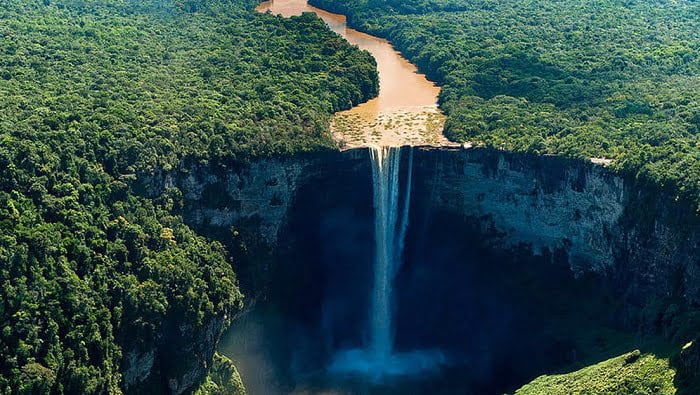
Guyana has 241 km³ of renewable freshwater resources, which placed it 31st in the world ranking in 2020. This South American country has many rivers and lakes, the main ones being the Essequibo River, the Demerara River and Mainstay Lake.
Average rainfall and soils of Guyana
Guyana has an average annual rainfall of 2,387 mm, which places it 15th in the world. Because of this high moisture, Guyana’s soils are generally very moist and rich in nutrients, which makes them ideal for agriculture and forestry.
Forest resources of Guyana
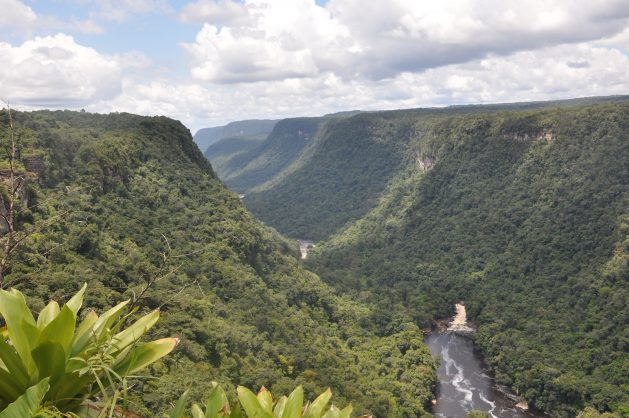
Forests cover 87.09% of Guyana’s land area, equivalent to 183,877.3 km², according to 2023 data (World Bank).
Environmental performance and protection of Guyana’s natural resources
Guyana is a country with a rich diversity of natural resources. On the Environmental Performance Index (EPI 2024, Yale University), Guyana scored 49.0 and ranked 67th out of 180 countries. Protecting natural areas is essential to preserving biodiversity and ecological balance, and protected areas cover 8.4% of Guyana’s land area (World Bank, 2025).
Natural parks of Guyana: the hidden wealth of natural resources
Biodiversity: animal and plant resources of Guyana
Birds of Guyana
Guyana has a great diversity of birds, with 795 species in total, ranking 29th in the world. Although it has no endemic bird species, it is worth noting that 16 of its species are endangered.
Among the most notable species is the scarlet macaw, one of the country’s most emblematic birds.

Fish and amphibians of Guyana
In 2019, 135 amphibian species were recorded in the country, placing it 25th in the world.
Guyana also has a total of 993 fish species, the main one being the arowana. The country ranks 49th in the world for number of fish species.
Mammals of Guyana
Guyana had a total of 235 mammal species in 2016. However, 11 of them are threatened.
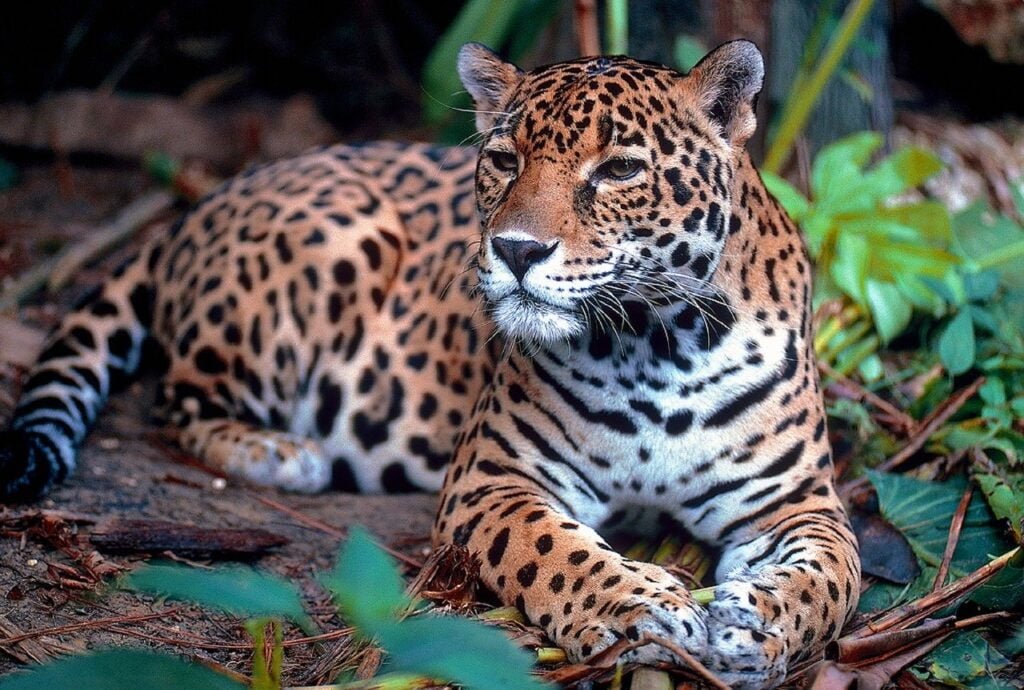
The conservation of these natural resources is very important, especially that of the country’s flagship mammal, the jaguar.
Reptiles of Guyana
Guyana has rich biodiversity, especially when it comes to reptiles. With a total of 185 reptile species, it ranks 45th in the world.
The green anaconda stands out.
Plants of Guyana
Guyana has a great diversity of vascular plants, with a total of 7,112 species recorded in 2020, which places it 26th in the world. Among the country’s most notable species is Victoria amazonica, an imposing aquatic plant that can reach up to 3 meters in diameter and is known for its huge floating leaves.

Organizations that protect or study Guyana’s natural resources
- Environmental Protection Agency Guyana: government agency that issues environmental permits and protects Guyana’s environment.
- Guyana Forestry Commission: national commission that administers and sustainably manages Guyana’s state forests.
- Protected Areas Commission Guyana: commission that establishes and manages Guyana’s national system of protected areas.
- Iwokrama International Centre: center dedicated to the conservation and research of Guyana’s tropical rainforest.
- WWF Guianas: international organization that conserves forests, water and wildlife in the Guianas.
- Conservation International Guyana: international program that protects the forests and communities of the Rupununi in Guyana.
The Stabroek block, off the coast of Guyana, holds an estimated gross recoverable resource of about 11,000 million barrels of oil equivalent, the result of more than 30 discoveries made since May 2015 (ExxonMobil, 2025). That find reshaped the resource profile of a country that until a decade ago depended almost entirely on gold, bauxite and timber.
Offshore oil from the Stabroek block
Production from the Stabroek block reached 900,000 barrels a day in November 2025, after the fourth offshore project started up in August of that year (ExxonMobil, 2025). Four floating production, storage and offloading units (FPSOs), including Liza Unity, Prosperity and ONE GUYANA, operate on the field, whose recoverable resource is estimated at about 11,000 million barrels of oil equivalent.
Gold and bauxite: the mining base before crude oil
Before oil, gold was the country’s main export. In 2019 Guyana exported 19,795 kilograms of gold, worth $876.6 million, ahead of any other product (USGS, 2019). Bauxite exports amounted to 1.91 million tonnes that year, and between 2016 and 2019 Guyana was the second-largest supplier of bauxite to the United States, with an average of 21% of those imports (USGS, 2019).
An economy reshaped by its resources
Guyana’s GDP grew 43.4% in 2024, driven by oil production that reached 225 million barrels, which places the country among the fastest-growing economies in the world (World Bank, 2024). The effect goes beyond crude oil: non-oil GDP rose 13.1% the same year, supported by public investment.
Sources used
- List of countries by mineral production – Wikipedia
- Economic data by country – The Global Economy
- Forest area (km²) – World Bank
- Forest area (% of land area) – World Bank
- Arable land area (km²) – World Bank
- Oil reserves – The Global Economy
- Water and agriculture statistics – FAO
- Precipitation (mm) – World Bank
- Environmental Performance Index – Environmental Performance Index
- Bird species – Mongabay
- Amphibian species by country – Mongabay
- Mammal species – Mongabay
- Endemic mammal species – Our World in Data
- Plant species – Mongabay
- Reptile species by country – Mongabay
- Endemic bird species by country – Our World in Data
The World Bank noted in 2023 that Guyana is one of the most heavily forested countries in the world, with more than 80% of its territory covered by tropical rainforest.
Last updated: September 26, 2026

Leave a Reply