

Tidal energy harnesses the rise and fall of the tides, while wave energy captures the motion of ocean waves. Both are renewable and predictable, but still marginal: at the end of 2024, the world had about 500 MW of installed ocean energy capacity, almost all of it from just two large barrage plants (IRENA 2024). If the ocean holds such enormous potential, why have we barely begun to tap it?
The sea never stops. Every day, the gravitational pull of the Moon and the Sun raises and lowers billions of tonnes of water, and the wind whips up waves that travel across entire oceans. Tidal and wave energy seek to turn that ceaseless motion into clean electricity. They are two forms of what is known as ocean or marine energy, and they have an advantage that no other renewable offers so clearly: the sea is predictable years in advance.
Contents
Even so, they remain an emerging source. According to capacity statistics from the International Renewable Energy Agency (IRENA, 2025), at the end of 2024 the world’s installed ocean energy capacity was only about 500 MW, and more than 90% of that figure came from two tidal barrage plants built decades ago; in Europe, just 12.7 MW of newer tidal stream turbines were generating electricity (Ocean Energy Europe 2025). To put that number in context, a single modern solar or wind farm can exceed that capacity.
In this article, you will learn what tidal and wave energy are, how their main technologies work, which benchmark projects exist in France, South Korea and the United Kingdom, and what obstacles are holding them back compared with other, already established alternative energy sources.

What are the differences between tidal energy and wave energy? What technologies exist to capture them? And why are countries such as France, South Korea, the United Kingdom and Canada leading their development?
Natural resources
Natural resources are materials or energy sources provided by or found on Earth that are useful to humans. Every product we manufacture is made up of natural resources.
- Renewable resources: these can be restored by natural processes faster than the rate at which they are consumed. Examples include solar radiation, wind, hydroelectric power, water when used properly, and plant and animal life.
- Non-renewable resources: once extracted, these are depleted and cannot regenerate. Examples include hydrocarbons, metals and minerals.
What is tidal and wave energy?
Tidal energy is energy obtained by harnessing the periodic rise and fall of sea level, that is, the tides. It is generated by the gravitational interaction between the Earth, the Moon and the Sun, combined with the Earth’s rotation. Because these astronomical forces are constant and calculable, tides can be predicted accurately for years ahead, which makes this one of the most reliable sources in the renewable catalog.
Wave energy, by contrast, harnesses the motion of surface waves, which form as the wind acts on the surface of the water. Unlike tides, waves depend on the weather and are more irregular, but they carry a high energy density, especially along the western coasts of continents at temperate latitudes, where the strongest winds blow.
Both belong to the family of marine renewable energy sources, and together with current energy, thermal gradient energy and salinity gradient energy they make up what is known as ocean energy. Their great appeal is that water is about 800 times denser than air, so a current of water carries much more energy than a current of air at the same speed (EIA 2024).
How does tidal energy work?
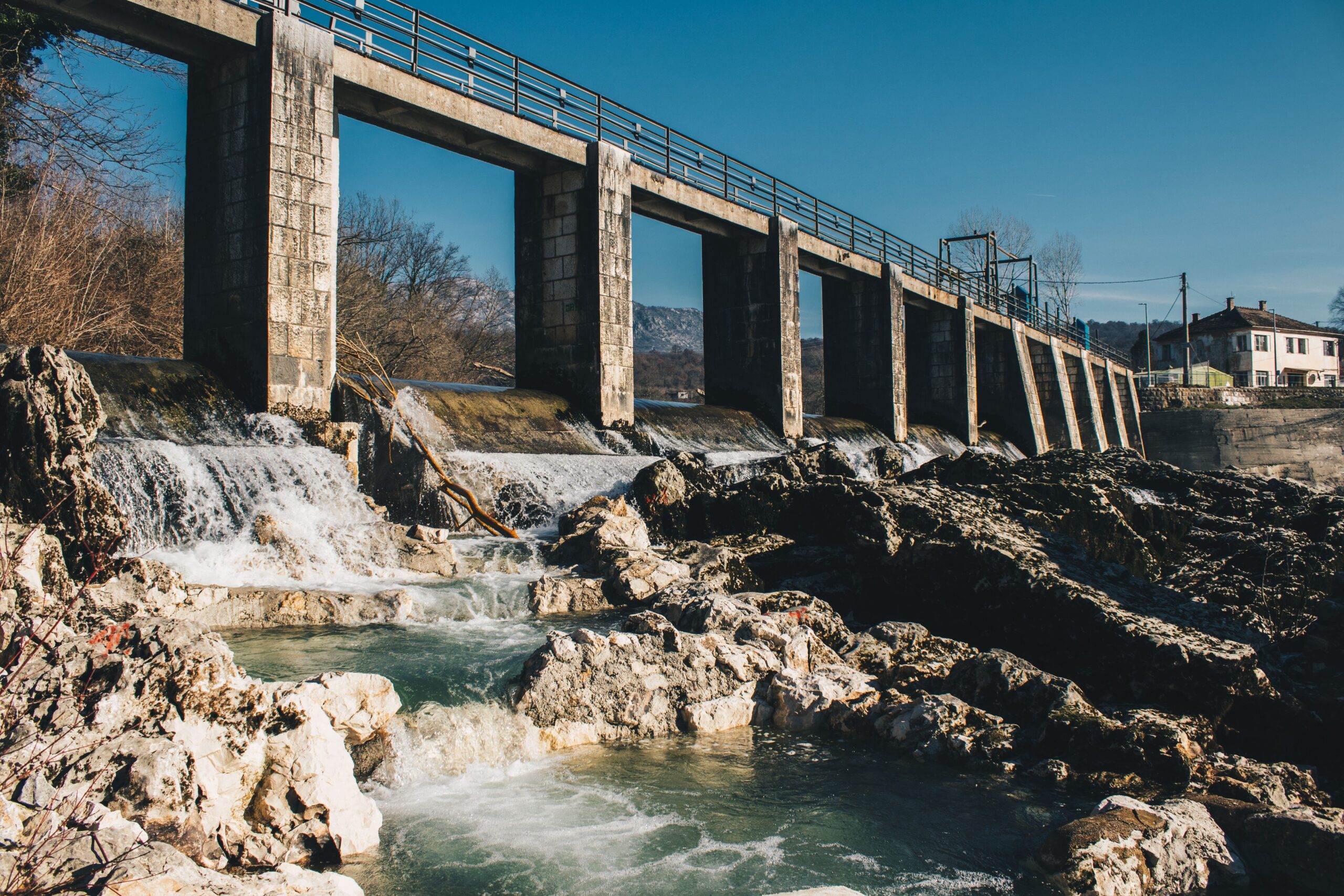
Tidal energy is harnessed in two basic ways: with barrages (tidal dams) or with current turbines. A tidal barrage works like a dam built across an estuary or bay. When the tide rises, water enters through sluice gates and fills the basin; when it falls, the water is released in a controlled way through turbines that spin and drive generators. Two-way systems produce electricity both as the basin fills and as it empties. For a barrage to be cost-effective, the US Energy Information Administration estimates that a tidal range of at least three meters is needed (EIA 2024).
The second approach is tidal stream turbines (also called dynamic tidal power). They work much like wind turbines, but underwater: their blades turn 12 to 18 times per minute, depending on the strength of the current, and drive a generator through a gearbox. Because water is much denser than air, these turbines must be sturdier and heavier than wind turbines, and they are anchored to the seabed in areas with strong currents. There is also a variant, tidal fences, which mount vertical-axis turbines in a row on the seabed, like a fence the water passes through.
Wave energy: harnessing the power of the waves
Wave energy is captured with wave energy converters, a very diverse group of devices that has not yet converged on a dominant design. Among the most studied are point absorbers, floating buoys that rise and fall with the swell and drive a hydraulic or electrical system; attenuators, long, jointed structures that flex with the waves; and oscillating water columns, coastal chambers in which incoming and outgoing water compresses and decompresses air that drives a turbine.
The theoretical advantage is enormous. The Intergovernmental Panel on Climate Change estimates that the global theoretical potential of wave energy is on the order of tens of thousands of terawatt-hours a year, far above current global electricity demand (IPCC 2011). The challenge is that only a very small fraction of that resource is technically and economically usable, and devices must withstand the corrosive environment and storms at sea for decades.
Installed capacity and key projects worldwide
The history of tidal energy is marked by a few landmark installations. The La Rance plant in Brittany, France, was the world’s first tidal power plant: it opened in 1966, has a capacity of 240 MW and was the largest on the planet for 45 years (EIA 2024). Its location in an estuary with a huge tidal range made it possible, and it still generates about 500 GWh a year. This kind of project is one of the reasons France ranks among the countries with the most experience in renewable natural resources on the Atlantic coast.
In 2011, the Sihwa Lake plant in South Korea overtook La Rance to become the world’s largest tidal power plant by capacity, with 254 MW and annual generation of about 552.7 GWh (Wikipedia 2024). It was built using an existing seawall on an artificial lake, which lowered costs and also helped improve the lagoon’s water quality. It is an example of how South Korea has integrated marine energy into its coastal natural resources.
The most ambitious tidal stream project is MeyGen, in the Pentland Firth off the north coast of Scotland (United Kingdom). It is the world’s largest tidal turbine array: its first phase brought several grid-connected 1.5 MW turbines online, and the long-term plan envisions expanding it to about 400 MW (NS Energy). MeyGen reflects British leadership in the field and complements the abundant natural resources of the United Kingdom geared toward marine renewables.
As the chart shows, almost all installed tidal capacity comes from two barrage plants. Other historic installations, such as Annapolis Royal on the Bay of Fundy (Canada) or Jiangxia (China), have far smaller capacity. This shows how concentrated and still experimental the sector remains, a trait that also shapes the natural resources of Canada linked to the Fundy tides, the highest in the world.
Global potential and leading countries
The tidal stream sector is starting to move. At the end of 2024, more than 200 MW of tidal turbine projects were under development, although the capacity actually in operation was still only a few megawatts (Ocean Energy Europe 2025). Europe accounts for much of this activity, led by the United Kingdom and France, followed by South Korea, Canada and China. The United States, by contrast, does not yet have any commercial tidal power plant, only demonstration projects in Alaska, Maine and New York (EIA 2024).
IRENA considers Europe the world leader in tidal and wave energy, and bodies such as the International Energy Agency’s Ocean Energy Systems (OES) program coordinate research among countries. The reason for the interest is clear: if the technology could be made cheaper, ocean energy could provide a firm, predictable source to complement solar and wind power, which depend on the sun and the wind.
Advantages and disadvantages compared with other renewables
The main advantage of tidal energy is its predictability: unlike the sun or the wind, tides are known precisely years in advance, which makes them easier to integrate into the grid. In addition, current turbines take advantage of the high density of water to capture a lot of energy in a small space, emit no greenhouse gases during operation and have a long service life, as La Rance shows after more than half a century in operation.
The main disadvantages are the high cost of construction and maintenance in a corrosive marine environment, the scarcity of sites with sufficient tidal ranges or currents, and the environmental impact of barrages, which can alter water levels, increase turbidity and affect estuary ecosystems (EIA 2024). Wave energy faces the added difficulty of withstanding storms and the lack of a standard design, which keeps its costs high and its deployment at an experimental stage.
Related links
If you want to keep exploring ocean energy and the natural resources of the countries developing it, you will find these articles useful:
- Renewable natural resources: what they are, types and examples
- Non-renewable natural resources: characteristics and examples
- Alternative energy is possible
- Natural resources of France
- Natural resources of South Korea
- Natural resources of the United Kingdom
- Natural resources of Canada
- Sustainable development projects
Sources used
- IRENA — Ocean energy (2024)
- Ocean Energy Europe — Ocean Energy Stats & Trends 2024 (2025)
- U.S. Energy Information Administration — Tidal power (2024)
- IPCC — Ocean Energy, Special Report on Renewable Energy (2011)
- Sihwa Lake Tidal Power Station — Wikipedia (2024)
- NS Energy — World’s biggest tidal power plants
Tidal and wave energy embody a paradox: the ocean holds one of the largest reserves of renewable energy on the planet, but tapping it remains expensive and complex. The successes of La Rance, Sihwa Lake and MeyGen show that the technology works; the remaining challenge is to cut costs and protect marine ecosystems so that these sources stop being a curiosity and become a real part of the energy transition.
Related articles
Last updated: September 26, 2026

Leave a Reply