


Norway’s natural resources are anchored by immense North Sea oil and natural gas reserves alongside an extraordinary hydroelectric power system. In 2024, the nation produced approximately 2.0 million barrels per day of oil—ranking as Western Europe’s top producer—and reached a record gas output of roughly 124 billion cubic meters. What natural resources drive Norway’s sovereign wealth and clean power grid?
Norway, situated across the western Scandinavian Peninsula, is celebrated for its dramatic glaciated fjords, expansive boreal forests, and pristine subarctic marine ecosystems. The natural resource base of Norway is both immense and economically transformative.
Table de contenidos
These endowments have historically formed the foundation of the Norwegian economy, transitioning from traditional cod fisheries to world-class offshore petroleum and natural gas extraction in the North Sea and Norwegian Sea. Simultaneously, Norway is a global titan in clean hydroelectricity and operates a certified sustainable timber industry.
Which natural resources drive Norway’s economic resilience? What strategic minerals does it produce, and how does it rank internationally? How much freshwater does it control, what empowers its renewable grid, and how diverse is its Scandinavian wildlife?
To examine Norway’s position within the wider European continent, explore our overview of Europe’s natural resources and our global directory of natural resources by country.
Natural Resources
Natural resources are naturally occurring materials and energy sources provided by the Earth that sustain human civilization and economic activity.
- Renewable resources: Can replenish naturally through ecological cycles faster than they are depleted. Prominent examples include solar radiation, wind currents, hydroelectric water runoff, marine fish stocks, and sustainably managed forests.
- Non-renewable resources: Formed over geological timescales, these finite reserves diminish permanently with extraction. Primary examples include crude petroleum, natural gas, coal, and metallic mineral resources.
Examples of Norway’s Main Natural Resources
Norway: State of Forests and Environmental Indicators
Forest surface evolution and national environmental context.
| Forest cover | 33.5 % of land area2023 |
|---|---|
| Forest area | 122,034 km²2023 |
| Annual forest area change | +78 km² per year (2018–2023) |
| Agricultural land area | 2.7 % of territory2023 |
| Protected terrestrial area | 17.8 % of territory2025 |
| Threatened species | 71 mammals, birds, fish and plants2022 |
| Resource | Reserves / Production | Source |
|---|---|---|
| Petroleum | ≈2.0 million bpd (2024); largest in Western Europe | Worldometers / EIA |
| Natural gas | ≈124 billion m³ (2024); all-time record, largest in Europe | Rigzone / Norwegian Petroleum |
| Aluminum (primary) | 1,300 thousand t (2019); 8th globally | USGS |
| Freshwater reserves | 424.4 km³ (2020); 24th globally | FAO AQUASTAT |
| Average precipitation | 1,414 mm/year; 55th globally | World Bank |
Oil and Natural Gas Resources in Norway
Norway is one of the world’s premier petroleum exporters. In 2024, daily crude oil production reached approximately 2.0 million barrels per day, cementing the country’s status as Western Europe’s largest oil producer (Worldometers).
Proven petroleum reserves stood at an estimated 5,138,767,000 barrels as of 2022, ranking Norway 19th globally. Key producing offshore fields are concentrated across the North Sea, the Norwegian Sea, and expanding developments in the Barents Sea (such as Johan Sverdrup and Snøhvit).
Norway also holds world-scale natural gas wealth, achieving a historic record production of roughly 124 billion cubic meters in 2024, firmly consolidating its role as the European Union’s foremost gas supplier (Rigzone).
Examples of Norway’s Mineral and Metal Resources
In 2016, Norway registered coal reserves of 1,102,310 tonnes, primarily situated in the Arctic archipelago of Svalbard where underground mining has historically supplied local power and metallurgical markets.
In 2019, Norway produced 1,300 thousand tonnes of primary aluminum, ranking 8th globally according to the USGS. Western Norway—particularly the Sunnmøre and Vestland regions—hosts major smelting facilities that leverage low-cost, zero-emission hydropower to produce low-carbon aluminum for international markets. Explore our global assessment of mineral resources.
Water Resources of Norway
Norway holds an extraordinary renewable potable freshwater reserve of 424.4 km³, ranking 24th globally in 2020 according to the FAO. Glaciated alpine catchments feed high-gradient river systems, including the Glomma (Norway’s longest river at 621 km) and the Numedalslågen (352 km), as well as Lake Mjøsa, the country’s largest lake spanning 365 km². To learn more about global hydrologic cycles, see our guide on water resources.

Average Rainfall and Soils of Norway
Norway receives an average annual precipitation of 1,414 mm, ranking 55th globally. Atlantic weather fronts deliver heavy rain and snow along the western fjord coasts, maintaining saturated organic soils and continuous high runoff volumes that feed hydropower dams year-round.
Renewable Electricity and Hydropower Production in Norway
Norway is an undisputed global pioneer in renewable electrification, producing 149.63 TWh of renewable power annually. High-capacity hydroelectric stations, including the iconic Alta Power Station, generate nearly 90% of all domestic electricity. Learn more about clean power matrices in our guide to energy resources.
Forest Resources of Norway
Norway is enveloped by the Scandinavian boreal taiga, which spans vast interior valleys. As of 2023, forest cover reached 122,034 km²—representing 33.50% of national land area (World Bank)—placing Norway 46th globally in forest area. Read our comprehensive analysis of forest resources.
Composed primarily of Norway spruce (Picea abies) and Scots pine (Pinus sylvestris), these commercial woodlands supply timber, pulp, and bioenergy while acting as immense terrestrial carbon sinks.
Environmental Performance and Protection of Norway’s Natural Resources
Norway scored 69.9 on the 2024 Yale Environmental Performance Index, ranking 7th worldwide among 180 assessed countries (Yale EPI 2024). Protected land and marine conservation zones encompass 17.8% of national territory (World Bank, 2025), preserving fragile Arctic and subpolar wilderness areas.
Natural Parks of Norway: The Hidden Wealth of Natural Resources
Biodiversity: Animal and Plant Resources of Norway
Birds of Norway
Norway documents 254 bird species, hosting massive seabird breeding colonies along northern cliffs and coastal islands.
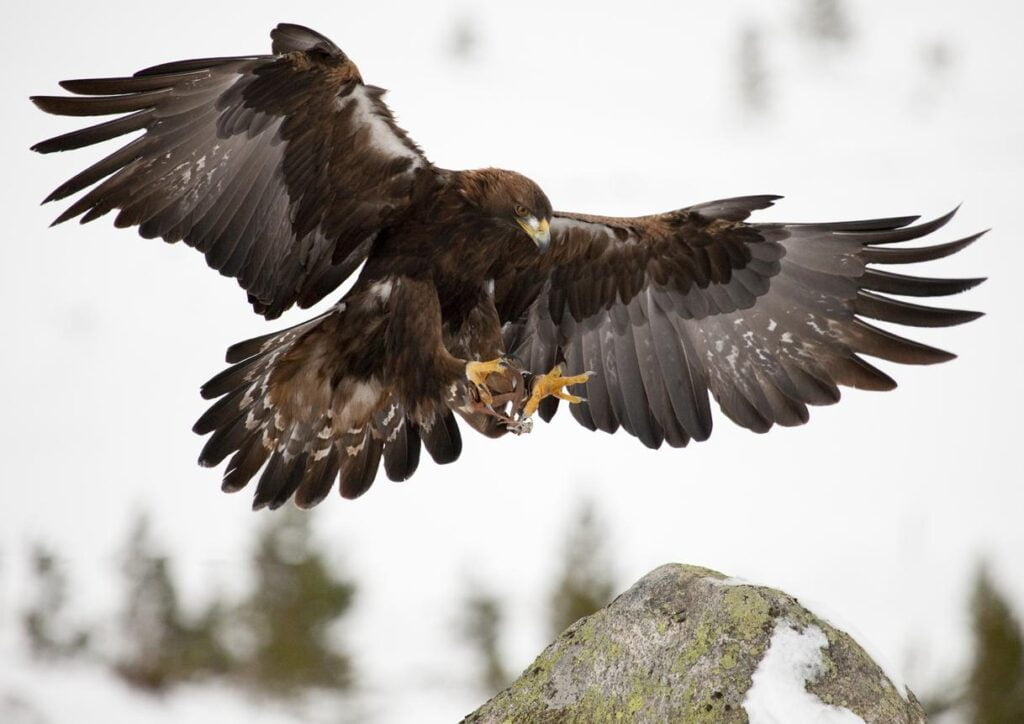
However, 11 species are threatened with extinction due to shifting marine food webs and warming sea temperatures. Apex raptors such as the golden eagle (Aquila chrysaetos) maintain stable nesting populations across mountain ranges.
Fish and Amphibians of Norway
Norway records 6 amphibian species (ranking 91st globally) and 292 fish species (ranking 156th). Its cold, oxygen-rich rivers are world-renowned for wild Atlantic salmon (Salmo salar), while cold-adapted amphibians like the moor frog thrive in taiga wetlands.
Mammals of Norway
Norway records 8 threatened mammal species, holding the 86th position in global mammal richness. Signature megafauna include the moose (Eurasian elk, Alces alces), wild reindeer on Hardangervidda, wolves, wolverines, and coastal seals.
Reptiles of Norway
Owing to high northern latitudes, Norway hosts 9 reptile species (134th globally). The common European adder (Vipera berus) is the most notable native venomous snake, adapted to survive long subarctic winters through seasonal brumation.
Organizations Protecting and Studying Norway’s Natural Resources
- Norwegian Institute for Nature Research (NINA): Foremost applied ecological institute researching biodiversity, wildlife management, and ecosystems.
- WWF Norway: Protects polar ecosystems, marine habitats, and national wilderness areas.
- Friends of the Earth Norway (Naturvernforbundet): Norway’s oldest environmental NGO advocating for nature conservation and sustainable resource management.
- Norwegian Environment Agency (Miljødirektoratet): State regulatory authority overseeing climate policy, pollution control, and conservation.
- Ministry of Climate and Environment: Government ministry formulating national environmental law and international climate commitments.
- Greenpeace Norway: Conducts campaigns defending Arctic marine systems and promoting rapid fossil-fuel phaseouts.
- Norwegian Institute of Bioeconomy Research (NIBIO): National research body advancing sustainable forestry, agriculture, and bio-based resource innovation.
Norway is Western Europe’s largest producer and exporter of crude petroleum and the European Union’s premier supplier of natural gas, according to official data from the EIA, 2024. That immense offshore hydrocarbon wealth coexists with a domestic electricity grid powered almost entirely by clean hydropower.
North Sea Oil and Natural Gas Dominance
Norway stands as Europe’s leading producer of petroleum liquids (EIA, 2024). In 2025, it exported approximately 122 billion standard cubic meters of natural gas, supplying over 30% of total gas consumption across the European Union and the United Kingdom, according to Norwegian Petroleum, 2025.
Electricity: An Almost 100% Hydroelectric Power Grid
Hydroelectric power generated approximately 88% of all Norwegian electricity in 2024, according to Ember Energy, 2024. When combined with wind energy, renewable sources satisfy nearly 99% of total domestic generation, as verified by Statistics Norway (SSB), 2025.
Marine Living Resources: World-Leading Salmon and Fisheries
Norwegian seafood exports achieved an all-time revenue record of NOK 175.4 billion in 2024, according to the Norwegian Seafood Council, 2024. Farmed Atlantic salmon generated NOK 122.9 billion—constituting 70% of total seafood value—with 2.8 million tonnes shipped to over 150 international markets.
Environmental Performance Benchmark
Norway ranked 7th globally on the 2024 Yale Environmental Performance Index with an overall score of 69.9 out of 100 (Yale University, 2024), reflecting exemplary air quality, water sanitation, and decarbonized grid infrastructure.
Authoritative Data Sources Used
- Annex: Countries by mineral production – Wikipedia
- Economic indicators by country – The Global Economy
- Forest area (km²) – World Bank
- Forest area as a percentage of land – World Bank
- Proven petroleum reserves – The Global Economy
- Global coal reserves – Worldometers
- Water and agricultural statistics – FAO AQUASTAT
- Mean annual precipitation (mm) – World Bank
- Environmental Performance Index (EPI) – Yale University
- Avian species by country – Mongabay
- Amphibian species by country – Mongabay
- Vascular plant species by country – Mongabay
- Reptile species by country – Mongabay
- Endemic bird species by country – Our World in Data
The Norwegian Water Resources and Energy Directorate (NVE) confirmed in official 2023 statistics that over 90% of Norway’s electricity is generated by hydroelectric dams, making Norway one of the highest per-capita producers of renewable energy in the world.
Last updated: August 19, 2026 (Comprehensive review of official indicators and natural resource balance sheet)

Leave a Reply