Mexico is one of the most megadiverse countries in the world: according to CONABIO, it holds about 12% of the planet’s terrestrial biodiversity and ranks second in reptile species richness, third in mammals and fifth in amphibians and vascular plants. Its challenge is to conserve this natural wealth while its economy grows. What progress has sustainable development made in Mexico, and what challenges remain?
Mexico is one of the most megadiverse countries in the world; an estimated 12% of the planet’s terrestrial biodiversity is found there, according to CONABIO. It ranks second in the world in reptile species richness, third in mammals and fifth in amphibians and vascular plants.Economic development in recent years has greatly benefited Mexicans, but it has also taken a toll on the country’s biodiversity and environment. Today the nation faces a major challenge: it must keep developing its economy and improving its people’s quality of life while protecting its natural wealth for future generations. In other words, it must achieve sustainable development.Although the indicators generally show that Mexico is still far from achieving sustainable development, there are many reasons, and many examples, to believe it could be achieved in the near future.
Sustainable development trends in Mexico
Per capita carbon dioxide emissions in Mexico have remained fairly stable since 1990, between 3.5 and 4.3 tonnes per person (3.6 tonnes in 2024, according to the World Bank), at levels similar to those of Argentina (4.0 tonnes in 2024).
According to the World Bank, the depletion of mineral, forest and energy resources was equivalent to 4.4% of Mexico’s gross national income (GNI) in 1980, 2.5% in 2000, 3.9% in 2010 and 2.8% in 2021. This shows that Mexico still depends in part on its natural wealth for its economic development.More: natural resources of Mexico
Deforestation in Mexico
Mexico covers an area of nearly 2 million km². According to FAO’s Global Forest Resources Assessment 2010, 33% of it was forest and 10% was other wooded land; of the forest area, 53% was primary forest, 42% was naturally regenerated forest and 5% was planted forest.
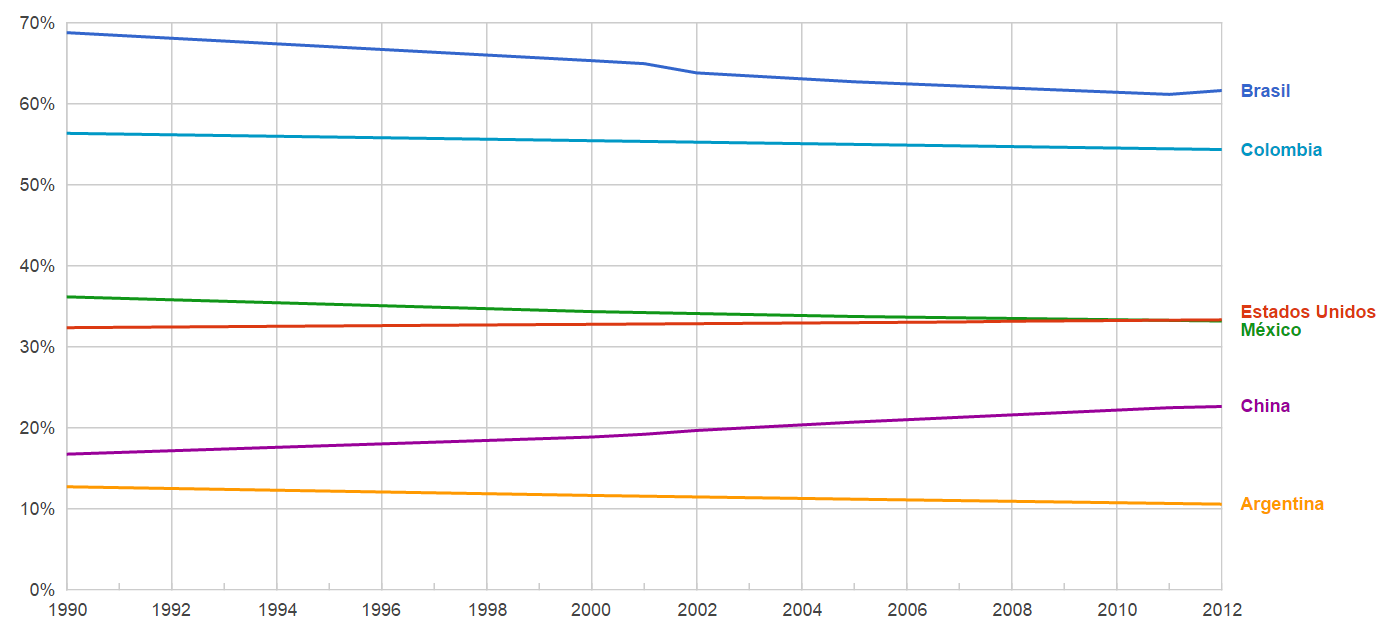
Deforestation in Mexico has several causes. The main one is land-use change for agriculture or livestock farming. Other causes include the overexploitation of wooded areas for logging (legal and illegal), mining, urban development, forest fires and natural disasters.Forest conservation in Mexico is limited: only 13% (2010) of the country’s forest area has biodiversity conservation as its primary function. This share is insufficient and pales in comparison with countries such as Ecuador (49%), Peru (27%), Venezuela (34%) and the United States (25%).Mexico’s forest area as a percentage of its total land area declined slowly between 1990 and 2010, from 36.2% to 33.3%, unlike in some developed countries such as Spain and the United States, where it grew. The good news was that deforestation in the country was slowing: about 354,000 hectares of forest were lost each year in 1990–2000, 235,000 hectares in 2000–2005 and an average of 155,000 hectares per year between 2005 and 2010. FAO’s revised series, published by the World Bank, puts Mexico’s forest cover at 36.3% of its land area in 1990 and 33.6% in 2023.
Sustainable development projects in Mexico
Many initiatives have taken on the challenge of sustainable development in Mexico. Some examples are green building, forest protection and cleaning up the air.
Examples of sustainable development in Mexico:
Creating community forest enterprises
This project, cofinanced by the Global Environment Facility (GEF) and CONAFOR (Mexico’s National Forestry Commission) in cooperation with the Rainforest Alliance, was designed to create community forest enterprises that contribute to local development by generating jobs and community assets, while also helping to conserve forests and protect the environmental services they provide.
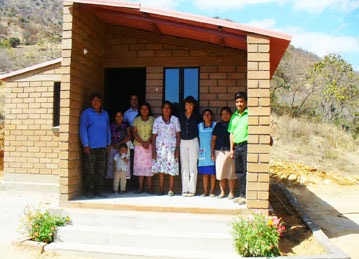
This initiative for organized self-production and self-construction of housing aims to provide decent homes for low-income families by building houses with the participation of the community.
In 2012, it committed to providing US$25 million in low-cost financing over the following five years to help low-income families build their own eco-friendly homes, equipped with fuel-saving stoves, biodigesters and rainwater purification systems.
PROAIRE
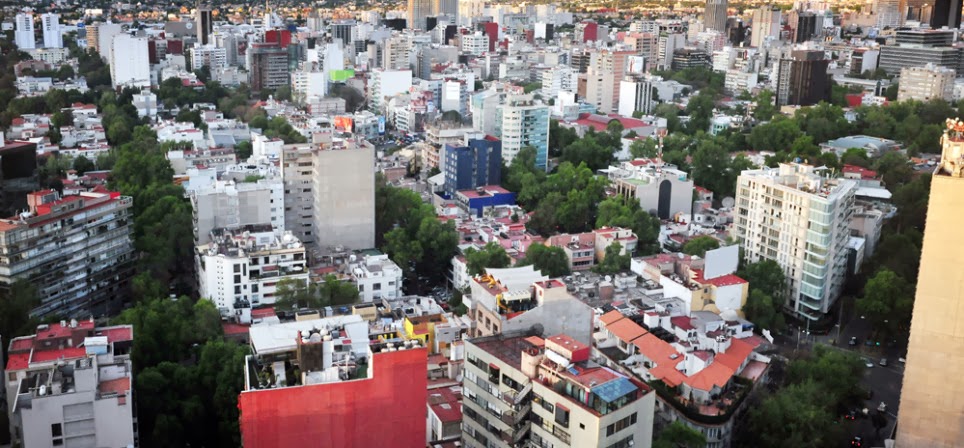
This initiative sought to improve air quality in the Valley of Mexico Metropolitan Area over the 2011–2020 period through a range of strategies, including renewing public passenger transportation, expanding the metro, encouraging cycling with bike lanes, managing green spaces, reforestation, and strengthening institutions and scientific research, among others.The plan was expected to cut emissions by more than 490,000 tonnes of pollutants, 5,000 tonnes of toxic pollutants and 5,500,000 tonnes of greenhouse gases. More examples: Mexico’s natural heritage: one hundred success stories. Other ecological projects in schools and universities
Ecological footprint and biocapacity in Mexico
Mexico’s biocapacity per person has declined steadily, from 3.7 global hectares in 1961 to 1.2 in 2023, mainly because of population growth: the country’s total biocapacity grew by only about 10% over the same period.
Meanwhile, the ecological footprint per person grew from 2.0 global hectares in 1961 to more than 3 in some years of the 2000s as consumption rose, and stood at 2.6 in 2023. In 1978, Mexico went from being a country with an ecological reserve to one with an ecological deficit.
Mexico’s ecological impact compared with other countries
The ecological footprint is a standardized measure of human demand on the earth’s ecosystems. It represents the amount of land and sea area needed to supply the resources a population consumes and to dispose of its waste. Total biocapacity is the capacity of a specific biologically productive area to generate a regular supply of renewable resources.
In 2023, Mexico had an ecological footprint of 2.6 global hectares per capita, while its biocapacity was 1.2 global hectares, which left Mexico with a deficit of 1.4 global hectares.
Compared with other Latin American countries at a similar level of economic development, such as Argentina and Brazil, Mexico has a similar ecological footprint (2.6 global hectares per person in 2023, compared with 2.8 and 2.4) but much lower biocapacity (1.2, compared with 4.9 and 8.2), which leaves it with an ecological deficit while both of them have an ecological reserve.
Economist from the Universidad de Antioquia (Medellín, Colombia), covering the environment and sustainable development since 2013. The work here begins with hands-on research in the databases of the major international research institutions — the World Bank, FAO, the United States Geological Survey (USGS), the United Nations and the OECD — the source of every indicator published on this site, each one cross-checked. The aim is to turn that data into a simple, visual format: tables, maps and visualizations that make each country's environmental situation clear at a glance.






Leave a Reply