Climate change in Mexico is already being felt, and it will intensify in the coming decades. What consequences does it have for the country? In 2002, 44.9% of its soils were already degraded, at least 2,678 species are at risk according to CONABIO, and between 1970 and 2025 the country recorded an average of 7,095 forest fires a year, a figure that is expected to rise.
The consequences of climate change for Mexico are already being felt, and they are expected to become even more pronounced in the coming decades. Various international organizations, such as the World Bank, forecast more intense cyclones, shrinking arable land, biodiversity loss, flooding, fires and more.
Contents
Sea level rise in Mexico due to climate change
As temperatures rise because of climate change and the polar ice melts as a result, global mean sea level is likely to rise by 0.28 to 1.01 m by 2100 (relative to 1995–2014), depending on emissions, according to the IPCC (2021).
This rise in sea level will cause significant damage to the islands in the Caribbean and to the country’s coastal cities, such as Puerto Vallarta and Mazatlán. In coastal regions and on islands, for example, rising seas can affect freshwater wetlands and make it harder to supply drinking water. Flooding and land loss will also become more common in coastal regions.
More frequent tropical storms in Mexico due to climate change
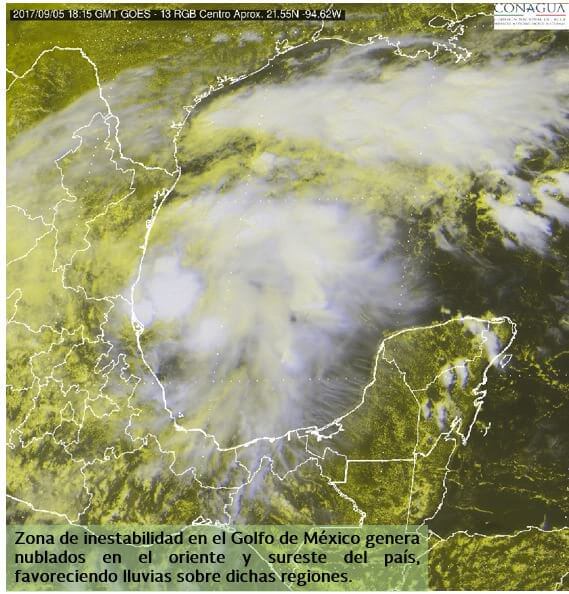
The Caribbean and Central America are already among the regions of the world most vulnerable to tropical storms and hurricanes. Mexico, especially the Gulf of Mexico and Caribbean region, is particularly at risk because, as the World Bank noted in 2012, population and infrastructure there have been growing faster than the national average. Millions of people are exposed to the next megastorm.
As storms increase, Category 5 hurricanes such as Gilbert or Patricia are expected to occur again; in October 2023, Hurricane Otis made landfall in Acapulco as a Category 5 hurricane.
Loss of arable land in Mexico
According to SEMARNAT, 44.9% of the country’s soils suffered from some form of degradation in 2002, caused by overgrazing, excessive pesticide use or poor water management. With climate change and rising temperatures, droughts are expected to last longer and desertification to spread across many parts of the country.
The most vulnerable areas are Chihuahua, Coahuila, Sinaloa, Jalisco and Sonora.
Climate change and rainfall in Mexico
Climate change will increase rainfall in Mexico. In the future, the most exposed areas will experience more intense precipitation.
This makes it necessary to adapt cities’ water infrastructure to protect people from potential heavy rains or severe storms. The situation is already reaching critical levels. In Mexico City, for example, the drainage system is frequently overwhelmed by rain.
Climate change in Mexico and biodiversity loss
In Mexico, at least 2,678 species of plants and animals are at risk, according to the current list in NOM-059-SEMARNAT-2010, updated in 2019 (CONABIO). Although the causes vary (ecosystem loss, the introduction of exotic and invasive species, pollution, etc.), climate change and its consequences are among the most important.
Climate change will bring higher temperatures, heat waves, increasing desertification and more. As a result, forests turn into fuel for fires, and fires become more common. Between 1970 and 2025, Mexico recorded an average of 7,095 forest fires a year, according to CONAFOR, and this number is expected to rise.
Ecosystems are also shrinking, mainly because of land-use change: according to CONABIO’s Fifth National Report (2014), since the mid-20th century Mexico has lost, in net terms, 23.4 million hectares of tropical forest, 12.9 million of temperate forest, 5.8 million of scrubland and about 6.5 million of grassland, converted to farming and livestock land.
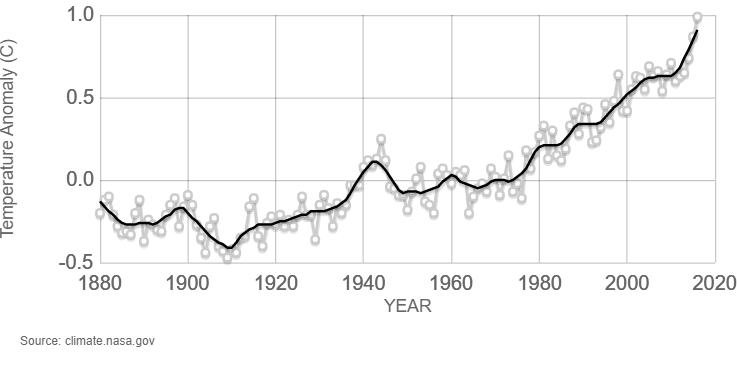
Global land-ocean temperature index
The eleven warmest years since records began in 1880 are the eleven most recent (2015–2025): according to NASA, 2024 was the hottest year ever measured (1.29 °C above the 1951–1980 average), and 2025 ranked second (1.19 °C above the 1951–1980 average), effectively tied with 2023.
Economist from the Universidad de Antioquia (Medellín, Colombia), covering the environment and sustainable development since 2013. The work here begins with hands-on research in the databases of the major international research institutions — the World Bank, FAO, the United States Geological Survey (USGS), the United Nations and the OECD — the source of every indicator published on this site, each one cross-checked. The aim is to turn that data into a simple, visual format: tables, maps and visualizations that make each country's environmental situation clear at a glance.




Leave a Reply