


Germany’s natural resources span minerals, forests and water. It is Europe’s largest lignite producer, at close to 102 million tonnes in 2023, and holds a freshwater reserve of 154 km³. Its biodiversity includes species such as the lynx, red deer and wild boar. What are the natural resources of Germany?
Germany, one of Europe’s most populous countries, has a diverse geography of mountains, plains and coastline. Germany’s natural resources are varied, running from minerals such as coal and salt to forests and rivers with a wide range of plant and animal life.
Table de contenidos
Germany’s biodiversity is significant, with species such as the lynx, red deer and wild boar living in its forests. The German economy benefits from these natural resources, which are used to produce energy, food and other goods.
What are the natural resources of Germany? What natural wealth does the country hold? Where does it sit in the world rankings for mineral resources? How is energy generated in Germany, and how is water managed? What range of wildlife and plant life lives in Germany?
Natural Resources
Natural resources are materials or energy sources provided by or found on Earth that are useful to humans. Every product we manufacture is made up of natural resources.
- Renewable resources: these can be restored by natural processes faster than the rate at which they are consumed. Examples include solar radiation, wind, hydroelectric power, water when used properly, and plant and animal life.
- Non-renewable resources: once extracted, these are depleted and cannot regenerate. Examples include hydrocarbons, metals and minerals.
Examples of Germany’s main natural resources
Germany: water, forest and protection
Key indicators of the country’s natural assets, with the reference year for each.
| Renewable fresh water per capita | 1,286 m³ per year2022 |
|---|---|
| Forest cover | 32.7% of the territory2023 |
| Annual change in forest area | stable (2018–2023) |
| Protected land area | 39.2% of the territory2025 |
| Protected marine areas | 45.3% of its waters2025 |
| Threatened species | 104 mammals, birds, fish and plants2022 |
| Resource | Reserves / Production | Source |
|---|---|---|
| Lignite (brown coal) | ≈102 million t (2023); Europe’s largest producer | Clean Energy Wire |
| Oil | 35,664 barrels/day (2021); 39th worldwide | EIA 2021 |
| Aluminum | 529 thousand t (2019); 17th worldwide | USGS 2019 |
| Fresh water | 154 km³; 46th worldwide | FAO |
| Natural gas | 4.1 billion m³ (2024); 50th worldwide | EIA |
Oil and gas resources in Germany
Germany produced 35,664 barrels of oil per day in 2021, placing it thirty-ninth worldwide. Its oil reserves as of 2022 are estimated at 132,480,000 barrels, placing it sixty-second worldwide.
Germany is not known as a major oil producer. Its main oil-producing states are Schleswig-Holstein, home to the Mittelplate field in the Wadden Sea, and Lower Saxony.
Germany is a mid-sized gas producer, with dry natural gas output of 4.1 billion cubic meters in 2024 (EIA). The country sits fiftieth (50th) in the world ranking.
Examples of Germany’s mineral resources
Germany is a significant producer of coal, mainly lignite, with output close to 102 million tonnes in 2023, keeping it Europe’s largest lignite producer (Clean Energy Wire).
It also holds large coal reserves, totaling about 36.1 billion tonnes as of 2016, or 3.50% of the world’s coal reserves. Hard coal mining in the Ruhr basin, in the west of the country, ended in 2018; output now comes from lignite mines in the Rhineland, Lusatia and Central Germany.
In 2019, Germany produced a total of 529 thousand tonnes of aluminum, placing it seventeenth in the world ranking. The main aluminum-producing region in Germany is North Rhine-Westphalia, home to major companies in the sector such as Novelis, Hydro and Trimet. Aluminum production is an important sector for the German economy, since the metal is used across a wide range of industries, from construction to car and aircraft manufacturing.
Other minerals found in abundance in Germany are salt and potash, extracted on the fringes of the Harz mountains. Extraction of most metallic minerals ceased for economic reasons in West Germany before reunification.
Water resources of Germany
Germany holds a freshwater reserve of 154 km³, placing it forty-sixth (46th) worldwide. This European country has a great many rivers and lakes, the most notable being the Rhine and the Elbe, along with Lake Constance, the largest lake in Germany.

Average rainfall and soils of Germany
Germany has average annual rainfall of 700 mm, placing it ninety-seventh (97th) in the world ranking. German soils vary with the country’s actual humidity, and are mostly fertile and nutrient-rich thanks to the rainfall it receives.
Renewable electricity and hydropower production in Germany
Germany has substantial renewable electricity production: in 2025 renewables generated 295.7 TWh, 59% of its total generation of 500.5 TWh, and hydropower supplied 19.6 TWh (Ember, 2025).
Germany’s largest hydroelectric plant is the Goldisthal pumped-storage plant, in the state of Thuringia, with installed capacity of 1,060 MW.

Forest resources of Germany
Germany has an important forest region known as the Black Forest, which covers much of the southwest of the country. Forest area in Germany accounts for about 32.7% of its land area, extending over 114,190 km² according to 2023 data (World Bank).
Environmental performance and protection of Germany’s natural resources
Germany has an Environmental Performance Index (EPI 2024) score of 74.5 and ranks third worldwide (of 180 countries), among the best environmental performers. It also has 40% of protected land and marine areas relative to its total territorial area. That protection is essential to preserving the country’s natural resources. More: Environmental Performance Index 2024 – Yale.
Natural parks of Germany: the hidden wealth of natural resources
Biodiversity: animal and plant resources of Germany
Birds of Germany
Germany has a total of 311 species recorded in 2018. It ranks 116th in the world.
However, 11 of those species are endangered, so protecting and conserving this valuable natural resource matters.

Fish and amphibians of Germany
Germany has 22 amphibian species and 245 fish species, notably the salamander and, among fish, the pike. The country ranks 75th in the world for number of amphibian species and 164th for number of fish species.
Reptiles of Germany
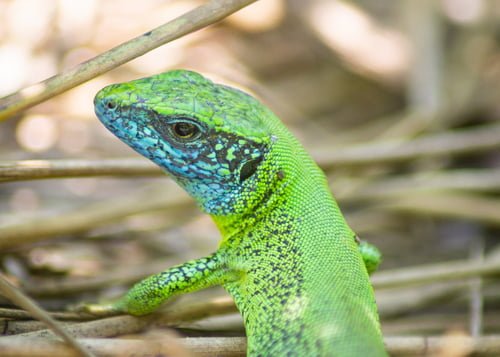
Germany has a total of 16 reptile species, placing it 127th in the world ranking for diversity of these animals. This natural resource is of great importance to the country, notably the European green lizard (Lacerta viridis).
Plants of Germany
Germany has a total of 2,660 species recorded in 2020, placing it 73rd worldwide. Among the most notable is the beech (Fagus sylvatica), an emblematic plant that covers much of the country’s woodland and is considered a keystone species for biodiversity conservation.

Organizations that protect or study Germany’s natural resources
- BUND – Protects biodiversity and natural resources in Germany through education and political action.
- NABU – Works to protect nature and the environment in Germany through species and habitat conservation.
- WWF Germany – Campaigns for nature and biodiversity conservation in Germany and worldwide.
- Greenpeace Germany – Works to protect the environment and promote renewable energy in Germany.
- Federal Environment Agency – Provides information and advice on environmental matters in Germany.
- Federal Ministry for the Environment, Climate Action, Nature Conservation and Nuclear Safety – Responsible for environmental policy in Germany and the protection of natural resources.
- Naturefund – Works to protect nature and biodiversity in Germany and worldwide through habitat conservation and environmental education.
In 2024, renewables covered 62.7% of Germany’s net public electricity generation and 56% of consumption, an all-time record, according to Fraunhofer ISE, 2025. The country is not notable for mineral deposits and imports most of its raw materials. Its defining feature is the Energiewende: the transition to renewables, the closure of its nuclear fleet and the scheduled exit from coal.
Germany’s Energiewende: renewables, goodbye to coal and the nuclear shutdown
Wind supplied 136.4 TWh (33% of net generation) and solar photovoltaic 72.2 TWh (14%) in 2024, according to Fraunhofer ISE, 2025. In 2025, wind and solar combined reached 45% of electricity, with wind at 27%, according to Ember, 2025.
- Renewables covered close to 56% of gross electricity consumption in 2025, according to Clean Energy Wire, 2025.
- The last three nuclear reactors were disconnected on April 15, 2023, according to Clean Energy Wire, 2024.
- Germany set its coal exit for 2038, according to Clean Energy Wire, 2023.
Lignite: from world leadership to shrinking open-pit mining
Germany was the world’s largest lignite producer from the start of industrial mining until China overtook it, according to Clean Energy Wire, 2023. Open-pit lignite mining has transformed 179,490 hectares of German territory, according to the same source.
- Electricity generation from lignite fell to 71.1 TWh in 2024, 8.4% less than in 2023, according to Fraunhofer ISE, 2025.
- Generation from hard coal fell to 24.2 TWh, down 27.6% year on year, according to the same source.
- Extraction is concentrated in three basins: the Rhenish, the Lusatian and the Central German, according to Clean Energy Wire, 2023.
Greenhouse gas emissions and their decline
Germany’s greenhouse gas emissions fell 48.2% between 1990 and 2025, from 1,253 to 649 million tonnes of CO₂ equivalent, according to Umweltbundesamt, 2026. In the electricity mix, CO₂ fell 58% against 1990, according to Fraunhofer ISE, 2025.
Environmental performance on the EPI
Germany scored 74.5 points and took third place worldwide on the 2024 Environmental Performance Index, according to Yale EPI, 2024. The index assesses 58 indicators across 11 categories, from climate to biodiversity and air pollution.
Forest cover and drought damage
Forest occupies 11.5 million hectares, close to a third of the territory, according to the fourth National Forest Inventory reported by DLG (BWI 4, 2020-2022), 2023. Drought, heat and bark beetles have degraded large areas since 2018.
- The 2020 Forest Condition Report put the area needing reforestation at 277,000 hectares, according to Clean Energy Wire, 2021.
- Four out of five trees showed thinned crowns, according to the same source.
Frequently asked questions
How much of Germany’s electricity comes from renewables?
They covered 62.7% of net public generation in 2024 and close to 56% of gross consumption in 2025, according to Fraunhofer ISE, 2025 and Clean Energy Wire, 2025.
Does Germany still produce coal?
It still produces lignite, with 71.1 TWh of generation in 2024 (8.4% less year on year), and has set its coal exit for 2038, according to Fraunhofer ISE, 2025 and Clean Energy Wire, 2023.
How far have German emissions fallen?
By 48.2% between 1990 and 2025, from 1,253 to 649 million tonnes of CO₂ equivalent, according to Umweltbundesamt, 2026.
Sources used
- Annex: Countries by mineral production – Wikipedia
- Economic data by country – The Global Economy
- Forest area (km²) – World Bank
- Forest area as a percentage – World Bank
- Arable land area (km²) – World Bank
- Oil reserves – The Global Economy
- Coal reserves – Worldometers
- Water and agriculture statistics – FAO
- Precipitation (mm) – World Bank
- Environmental performance index – Environmental Performance Index
- Bird species – Mongabay
- Amphibian species by country – Mongabay
- Plant species – Mongabay
- Reptile species by country – Mongabay
- Endemic bird species by country – Our World in Data
The Fraunhofer Institute for Solar Energy Systems (Fraunhofer ISE) reported that in 2024 renewables generated 62.7% of the country’s electricity.
Last updated: September 26, 2026
Leave a Reply